
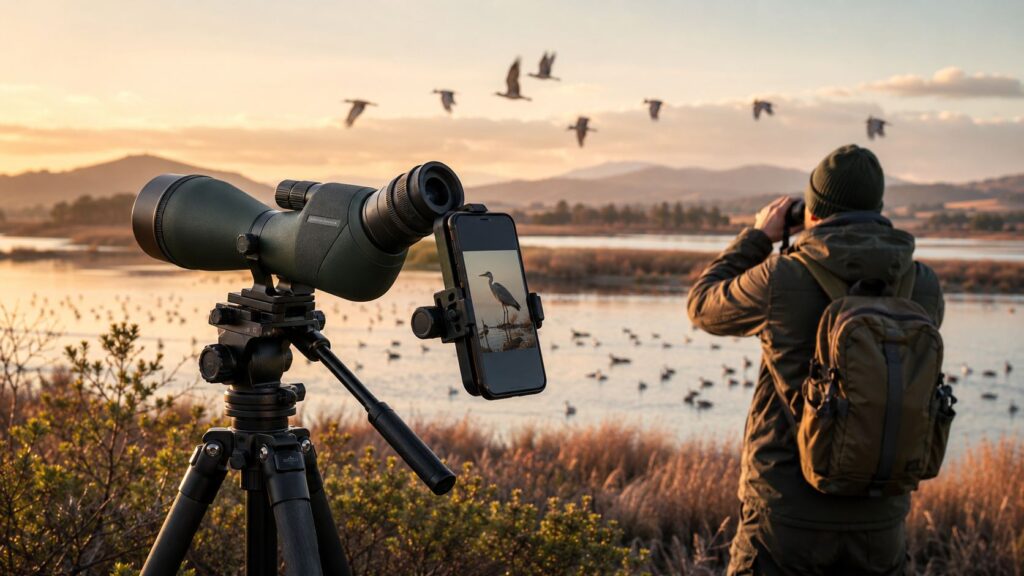
The ability to view a far off scene up close is what the spotting scope does best. For the birder it allows them to view the tiniest details on a species, such as the edge of a feather or the color of a birds eye. For wildlife observers a good spotting scope provides reach into valleys, across wetlands, along beaches and across open fields. Photographers also enjoy the use of a spotting scope, often practicing the art of digiscoping – that is taking photographs through the scope of a smart phone or even a camera.
Results are not all down to magnification. Good views of objects are determined by the optical glass, the coatings on the lenses, how the scope is supported and how it is focused. When all these factors are taken into account the spotting scope can be used as a bridge between the long-range viewing that it is designed for and the photography that can be so creative with such images.
While we use our binoculars for scanning wide areas and taking in a broad view, a spotting scope is best for taking a closer look at something. Generally speaking, a spotting scope has higher magnification than binoculars of the same size which allows you to get a closer look at small objects, read the movement of distant animals, and frame up a view that is out of reach with your everyday viewing optics.
Start by scanning at low power. At 15x or 20x, it is easier to find a bird on a branch, a deer at the tree line, or a boat on the horizon. Once the subject is centered, zoom in for detail. Jumping straight to high power often leads to hunting around a shaky, narrow view.
Zoom matters for Birdwatching and Wildlife photography: a wide angle of view is needed to follow a subject and then increase magnification as needed. And this holds for all other uses of zoom as well: Sport, Seascapes, the Moon. First see the story, then zoom in!
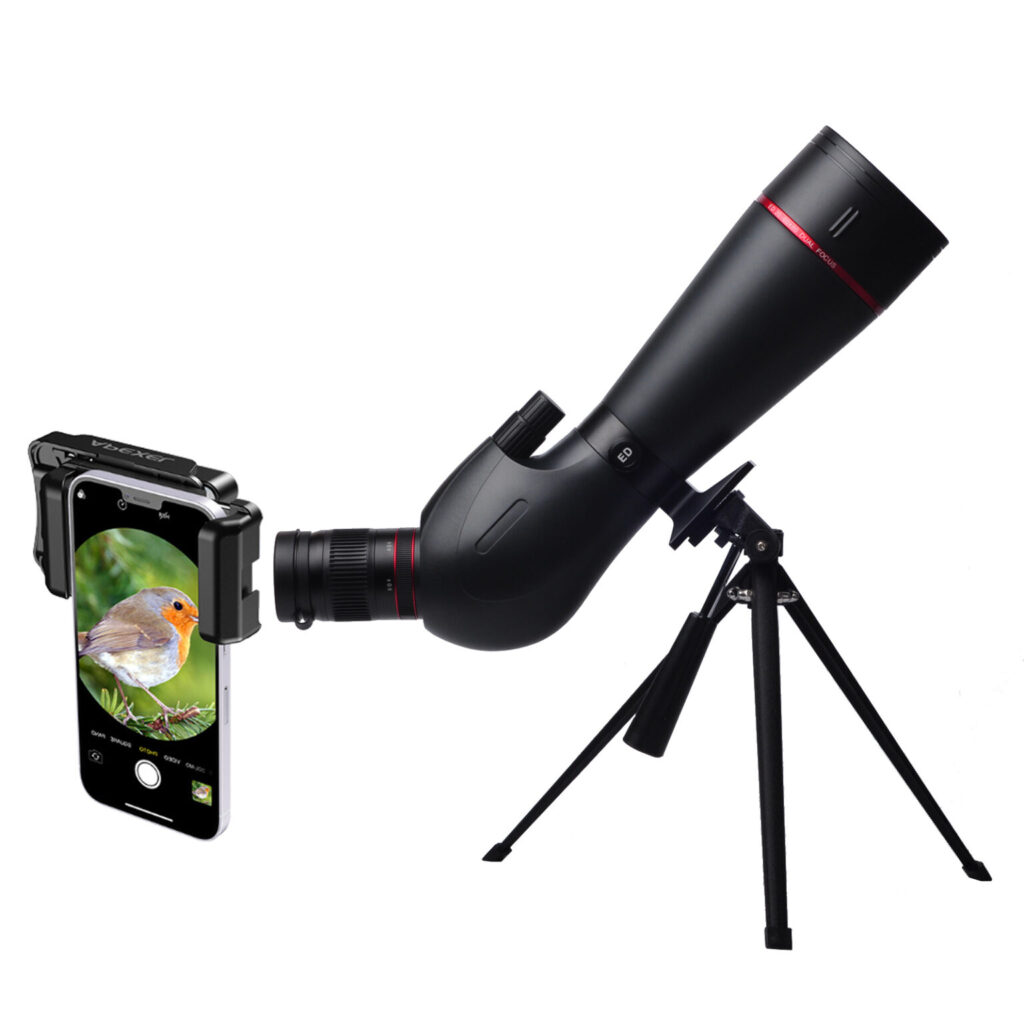
Every good spotting scope photograph is based on small habits. A film of dust on the objective lens, reflections, the scope shifting in the tripod, and heat shimmer in the air all can bring the sharpness of the spotting scope to a soft photograph before you even press the button on your smartphone or camera.
Install the scope on a stable surface or tripod. Start off with the lowest power and focus the scope roughly using the eyecup to bring your eyes to the correct position. Then slowly turn the zoom ring until the required power is reached, fine focus as necessary. The long eye relief of the scope allows for comfortable use by people wearing glasses, to avoid eye strain.
A dual-speed focusing system is very useful when your subject has fine texture or other details that need to be sharp, such as wing bars, fur, small text on a sign far away, or the many sharp edged lunar craters. Coarse focusing gets you there quickly, then fine focusing takes it to perfect sharpness without jerking the view.
Most soft images are caused by the air between the viewer and the subject. This air can be heated by the surface of roads, rooftops, sand or dry fields. The air then bends in the light traveling through it, causing the image to become wavy. Early morning and late afternoon are the times of day when the air is usually most steady and has the best color.
I prefer a simple lens hood over a fancy one for reducing side glare. Cleaning the glass on your lens is just as important as the rest of the camera. I use a blower first to remove any of the larger particles, and then gently clean with a microfiber cloth. Rubbing grit across coated glass can do far more harm than the dust itself.
Every little shake is visible at high magnification. Even a light touch on the focus wheel, a slight breeze or footsteps on a wooden floor can easily cause the image to get soft. Stable tripod mounting is essential for serious spotting scope photography.
| Field problem | Better setup habit | Why it helps |
| Windy ridge or beach | Hang a small bag from the tripod center | Adds weight and lowers vibration |
| Moving bird or athlete | Use a fluid head | Pans more smoothly |
| Phone shake | Use a phone adapter and timer | Keeps the lens aligned |
| High-power blur | Reduce magnification slightly | Adds light and steadiness |
| Uneven ground | Spread tripod legs wider | Lowers the center of gravity |
The key features of a tripod for spotting scopes are its height and stability against twisting. Many thin travel tripods are light enough to take with you on hikes, but may have difficulty holding larger scopes on shaky ground in windy weather.
The optimal position for your phone’s lens is directly on top of your eyepiece. If you see a black ring around your digiscoped image on your screen, you can very slowly move your phone up or down a couple of mm at a time until the whole image circle fits within the frame of your screen. Be sure to lock your digiscoping adapter before you take the photo, and then use a 2 second timer or a remote shutter to release the shutter.
Tap on your subject on your phone screen. If some highlights are blown out then just reduce the brightness a bit. Birds with white plumage, a very bright moon, and sun on water are typical “trick shots” for auto exposure.
A spotting scope provides a narrow field of view which is magnified. This limited field of view can be very beneficial, as it strips away clutter and focuses in on the main action. In addition, a spotting scope is able to pull all of the layers of distance ahead of you up close and personal. Small details in the scene ahead of you are now able to fill the entire frame of the spotting scope.
For a birdwatching setup for a spotting scope, try to place your tripod so that you are viewing a perch, a feeding area, a shoreline or open branch where birds may land for a bit and you can observe them for a while. Do not follow the birds with your tripod. Wait for the scene to develop. Side lighting will bring out the individual feathers of a bird’s plumage. Backlight will make a strong edge around the wings or fur of a mammal.
For wildlife photography, maintaining a distance can also be a form of respect. The scope on a camera can allow people to be at a safe distance from animals and be able to capture images with close-up detail. For example, when birds are nesting, grazing mammals on the move or shy wetland species a short video clip is often better than a still image.
The moon is an easy subject for creative photography. Try shooting the moon a few hours before dark when there is still some blue in the sky. The contrast will be easier to handle and the moon’s edge will be sharp. It’s best to avoid full digital zoom on the phone as the optical quality from the scope will be so much better than the pixels in the camera being stretched.
You can also view objects such as mountain layers, city skylines, lighthouses and ships with great detail when viewed through a spotting scope. The distant layers of objects appear much closer together than they do to the naked eye due to the extreme telephoto effect that a scope creates. You can also use a scope at sports to zoom in on players’ expressions, the movement of the ball and action on the sidelines from the seat where you are. Check venue rules to see if this is allowed.
When selecting a good quality spotting scope, one must match the scope to the intended use. A scope is a tool, and thus a backpacking birder, a coastal watcher, and a wholesale buyer who is establishing an line of outdoor optics would each evaluate somewhat different characteristics of a scope.
| Feature | What to look for | Best for |
| ED glass | Less color fringing and better edge detail | Birding, wildlife, moon viewing |
| High-magnification zoom | Smooth movement from wide to close view | Long-range observation |
| Wide field of view | Easier tracking of moving subjects | Birds, sports, open landscapes |
| Long eye relief | Comfortable extended viewing | Glasses wearers, long sessions |
| Waterproof and fogproof body | Sealed housing for wet or humid use | Field work, travel, marine areas |
| Stable tripod mount | Firm connection with standard supports | Digiscoping and high-power viewing |
A portable ED spotting scope in the mid-power area is a great travel, hiking, birdwatching scope for short set up’s. A larger long-range ED spotting scope with higher zoom and larger objective lens is best suited for fixed set up’s i.e. viewing from 1 spot and would be great for Moon viewing, Coast line viewing and any wildlife that is at a great distance. A long-range scope with dual-speed focusing is ideal for someone who wants to view the smallest of details.
Don’t let magnification be your only consideration. Users will care more about sharp images all the way to the edges, good coatings, water proofing, smooth mechanical operation and a solid, stable stand. A bright, stable 35x view will far out perform a dim, unsteady view at maximum power.
Hemusun Optical Instrument Co., Ltd. works in the research, development, manufacturing, and sales of optical instruments. Its product range covers outdoor optronics such as binoculars, monoculars, spotting scopes, rangefinders, night vision devices, astronomical telescopes, lenses, filters, magnifiers, microscopes, endoscopes, and optical components.
The strengths of the company for the customers buying spotting scopes are the features of a good spotting scope in a practical sense: High magnification zoom, high quality spotting scopes made from premium optical glass, solid and stable on a tripod, waterproof and fogproof, long eye relief, wide angle, spotting scopes produced as OEM/ODM and last but not least the production of optical components like binoculars, telescope lenses etc. with services like grinding, polishing, coating, cleaning, assembling and quality control.
A supplier of high-quality optical products for spotting scopes should be able to explain lens coatings, the mechanical structure, the mount stability, the packaging, the sample testing and the batch consistency. Hemusun’s broad range of optical products and flexible custom production enables it to be a practical business partner for companies that are introducing spotting scopes to their product range.
A good spotting scope is primarily good optics paired with good field technique. Thus, first and foremost start with low magnification and in the end only increase it as needed. Work to stabilize the scope in the tripod and choose a brighter day for viewing. Focus patiently and take the time to actually bring a subject into sharp relief. Then, when using a phone adapter for digiscoping, treat it exactly as you would a large, heavy and long telescope. You will be treated to a much closer and steadier view of birds and wildlife as well as landscapes far off, even the moon, and of course action at a distance.
When it comes to buying a spotting scope, the most important aspect for a buyer to consider is not the largest number on the box. For a spotting scope to be useful to a buyer, it must have clear glass, good coatings, a wide field of view, long eye relief, be able to withstand the weather, and be stable on a tripod.
Yes. For Spotting scope photography Digiscoping is common. By placing your phone or your camera in front of the eyepiece of your spotting scope good photos can be taken. To ensure sharp photos a phone adapter, a tripod and a timer is needed. Otherwise the images will be to poor to use.
For most birdwatching, starting at 15x to 25x should allow you to see the bird and follow it around. Higher magnification is for studying the details, and it requires more light, steadier air, and a tripod to remain stable.
Yes, especially for high-power observation and digiscoping. A tripod for your spotting scope will prevent any movement of the scope, you will have a sharp image all the time, and make long observation periods much more comfortable.
The use of ED glass will help to reduce fringing of color at objects with high contrast such as white against black as with a white bird sitting on black reeds or a bright moon against a dark sky. ED glass also helps to deliver the sharpest of images with the cleanest of colors.