

Choosing night vision gear starts with the viewing job, the operating conditions, and the detail that must remain useful. A practical decision weighs field of view, brightness, steadiness, focus, carrying limits, and the way the instrument will be handled. Browse optical product options and prepare a clear brief for a supplier.
The right choice becomes clearer when the next decision is tied to a real viewing condition rather than a single headline specification.
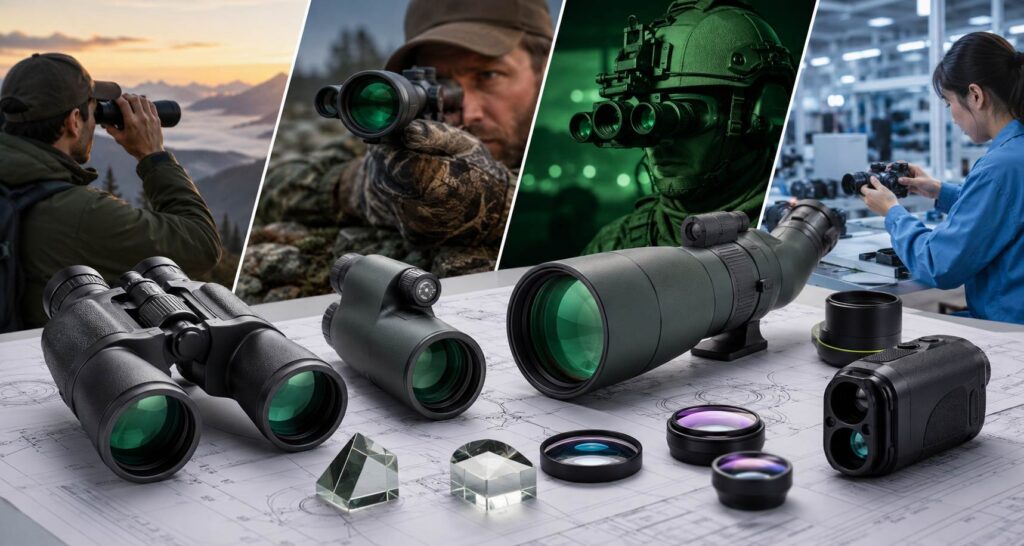
Night vision gear should be selected around the actual scene. Open ground, woodland, building edges, and changing twilight produce different levels of contrast and background light. State what must be detected, recognized, or followed before comparing devices.
Low light observation becomes harder when the subject moves or blends into the background. A portable night vision tool should be easy to raise, focus, and lower without losing the scene. Distance claims mean little without target size, weather, and available light.
The right choice becomes clearer when the next decision is tied to a real viewing condition rather than a single headline specification.
Night vision image clarity depends on the optical path, sensor behavior, focus, contrast, and scene illumination. Check the center and edges, then repeat after the subject moves. A bright image is not automatically a useful image if detail is washed out.
Night observation equipment is often used with gloves, a strap, or a support point. Focus and power controls should be reachable without covering the lens or disturbing the view. A short operating routine exposes awkward controls quickly.
| Buying factor | What to check | Why it matters |
| Field of view | Target acquisition and edge visibility | A wider usable view helps scanning and movement |
| Stability | Handheld shake and recovery after focus | Detail is useful only when the image stays calm |
| Handling | Grip, controls, carrying method | A practical tool is more likely to be used |
The right choice becomes clearer when the next decision is tied to a real viewing condition rather than a single headline specification.
Night vision scope mounting can improve longer observations, but support adds setup time and weight. Test the device handheld first, then from the intended rest or mount. Record how quickly the view settles after movement and refocusing.
Fog, humidity, dust, and reflective surfaces can change a low-light image. Keep the selection brief factual and practical: describe the expected environment, protection needs, cleaning routine, and storage conditions. Avoid treating a general rating as a guarantee for every scene.
A useful short list for a buyer:
The right choice becomes clearer when the next decision is tied to a real viewing condition rather than a single headline specification.
For portable low light optics, check detection of a fixed target, recognition of a textured target, focus from near to far, control reach, battery access, and carrying comfort. Repeat the process at twilight and in darker conditions when the intended use allows it.
A night vision equipment supplier should receive the task, distance, target movement, ambient light, mounting method, operating duration, weather, and user controls. Ask for samples or demonstrations that match those conditions instead of relying on a generic performance statement.
Hemusun Optical Instrument Co., Ltd. focuses on optical-instrument research, development, manufacturing, and sales. Its public product range includes binoculars and monoculars, while available services include OEM, ODM, wholesale, and retail work. A clear application brief helps connect the viewing task with a suitable optical configuration and sample discussion. Contact the optical team when a project needs a tailored specification.
The best night vision gear decision comes from matching the instrument to the target, distance, light, support, and handling routine. Compare the complete viewing experience, record practical limits, and give a supplier a specific brief so the final choice can be assessed through useful detail rather than a number alone.
A few practical questions often remain after the selection criteria are clear.
Start with the target, distance, light, movement, and carrying conditions. Those details determine which optical tradeoffs deserve the most attention.
No. More apparent scale can narrow the field, reduce brightness, and make hand movement more visible. Useful detail and stable handling matter more than the largest label.
Describe the target, viewing distance, light, support, operating time, user controls, and carrying limit. A specific brief makes sample evaluation clearer.