
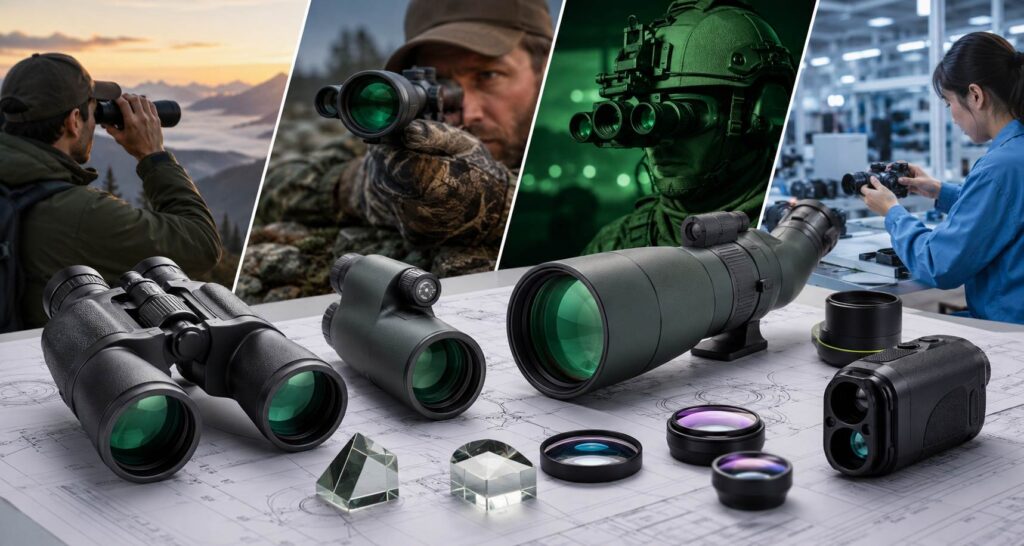
For brands, distributors, retailers, and outdoor equipment companies, choosing the right OEM/ODM optical instruments manufacturer is a critical business decision. Optical products such as binoculars, monoculars, spotting scopes, rangefinders, night vision devices, astronomical telescopes, lenses, and filters require much more than attractive exterior design. Their real value depends on optical clarity, coating quality, mechanical precision, structural durability, waterproof performance, and consistent mass production.
A reliable supplier for optical products helps you to avoid risks of purchasing, to get better prices for your products and to establish a sustainable and long term relationship with your customers. If you are planning to launch new binoculars on the market or want to create a customized version of a monocular for travelers, if you are searching for good quality spotting scopes for hunters or if you are in need of customized optical components, we can find the optimal manufacturer for your products to guarantee best quality and punctual delivery and to protect your brand name.
OEM, or Original Equipment Manufacturing, means a factory produces optical products according to your brand requirements, technical specifications, design ideas, packaging standards, or logo customization needs. OEM is suitable for buyers that already have a clear product concept or want to sell optical instruments under their own brand.
ODM, or Original Design Manufacturing, means the manufacturer provides existing product designs or helps develop new models that can be customized for your market. ODM is especially useful for startups, wholesalers, and e-commerce sellers who want to enter the optical products market faster.
We are professional OEM/ODM optical instruments manufacturer, we can support standard optical products, private label optical projects, custom optical product design and development, optical sample testing, optical mass production, optical quality inspection and optical export cooperation etc.
The first thing to do when selecting a supplier for optical products is to check if they have enough experience with the products you require. An optical manufacturer who is able to make binoculars will also be able to make monoculars, spotting scopes, rangefinders and even night vision and astronomical telescopes, magnifiers and microscopes, mobile phone lenses, filters and optical components.
A supplier who offers a wide range of products indicates that he is familiar with the required optical characteristics for different applications. Bird watching in nature for example requires a large field of view and sharp, color accurate images with sufficient brightness. Hunters on the other hand require robust housing, a water-proof design and good low light visibility. Travelers on the other hand are looking for light-weight and small products. Industrial customers require special lenses, filters or optical assemblies which are often custom-made according to strict specifications.
Don’t just compare suppliers on price and ability to make the product. More importantly, check if the supplier has experience with market and customers similar to yours. Then you can benefit from their market experience and design your product with more practical specifications and lower cost to you.
Optical performance starts with the quality of individual optical and mechanical components used in an optical system such as lenses, prisms, coatings, optical filters, and mechanical parts of an optical system. Any problem, however small, in the polishing, coating, centering, cementing or mounting of optical components will negatively affect the optical system’s performance by causing poor image quality, excessive glare, optical aberrations, and difficulties with focusing that may also translate into customer complaints.
When you are a brand and need custom optical components the technical capability of the manufacturer is most important. Typically such a manufacturer will have experience with rough grinding, fine grinding, polishing, centering of lenses, coating, gluing, blackening, cleaning, inspection and precise assembly.
With knowledge of optical processing your supplier can better control quality and delivery time. More important is that your supplier can better achieve your aims concerning performance and price. For example instead of raising spec and price he could advice on suitable coating, on lens material, on prism design and on housing design for your target market.
We work with our customers as an OEM/ODM optical products supplier and provide them with the benefits of customization. However, we believe that true customization is more than having a logo printed on a product.
There are many different options for customizing products, and depend on the specific product, they might include: magnification, objective lens diameter, field of view, eye relief, prism type, lens coating, focusing system, waterproof structure, rubber armor, body color, accessories, packaging, instruction manuals, product labels, and optical components.
An 8x42 binocular for wildlife observation could be a good choice for a binocular brand. A spotting scope of high magnification with a solid housing would be suited for a hunting distributor. A compact monocular for travel could be needed by a travel brand. Clients from industries could need custom filters or lenses of highest precision.
They should be able to provide a perspective of the potential value of different degrees of customization, indicate what can technically be done, and what would add value to customers as opposed to just cost. This is important, because excessive customization can add value only to a small number of customers, but drive up the cost of the product for the manufacturer in order to offer that variety to that customer.
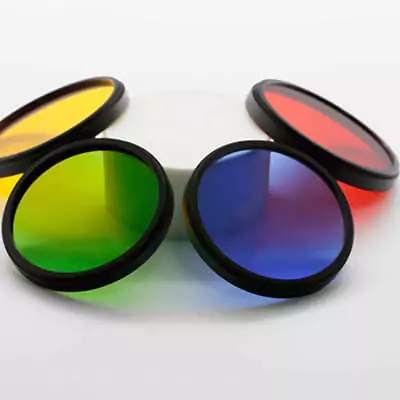
Quality control in optical manufacturing is important even for products that appear good from the outside. While a frame may look great for example, the lenses and any other optical elements can fail in a number of key areas including image quality, focus, prism alignment, water resistance and long term durability.
Before you place an order, find out how the factory will control quality in the following aspects: material selection, processing of components, assembly, inspection before shipment and packaging. For binoculars, monoculars and spotting scopes, a proper inspection will include: the surface quality of the lens, the coating, image quality, smooth focus, diopter correction, field of view, waterproof, fogproof and general appearance.
For rangefinders and night vision devices we check the functional properties, the display, the battery, the infrared, the accuracy of the measurement as well as the software.
By ensuring quality control is stable, you can avoid returns and protect your brand image. Online in particular, stable products also enable better reviews, more repeat business by word of mouth and more sustainable organic traffic in highly contested markets. Furthermore, satisfied customers translate into high levels of customer satisfaction.
An excellent OEM/ODM supplier should not only manufacture products for you but also be able to provide you the support you need. Having R&D and engineering team is crucial if you plan to launch new optical products, or to improve the existing ones.
Good engineering support answers practical questions such as: What is the right magnification for your intended use with your new product. Should it be a roof prism or a Porro prism design. Is ED glass appropriate for your product at this price point. How can you make the housing lighter without compromising durability. Which coating offers the best value for money in terms of brightness.
Design decisions influence the user experience and your bottom line. A manufacturer with optical engineering knowledge can prevent design mistakes, help reduce the time to market and produce optical components more consistently.
In addition to delivering samples a supplier must be able to deliver repeat orders with stable quality. Before starting a cooperation it is wise to check the minimum order quantity, the leadtime for samples, the leadtime for mass production orders, the possibilities for packaging, the production capacity and whether the supplier is able to send shipments.
Communication is equally as important as all other aspects of a professional supplier. Clearly outlined quotations, appropriate and accurate technical inquiries, confirmation of samples, updates on production and most importantly effective solutions to problems as they arise. International buyers in particular require smooth export documentation, safe packaging and consistent and predictable delivery.
Manufacturers can be evaluated not only by how fast they deliver, but also by how realistic their initial promised delivery time is.
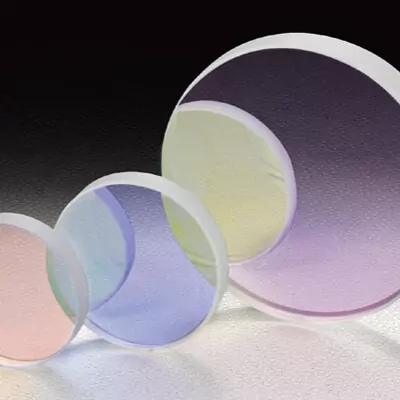
Price is a consideration but the lowest price is not always the best value. Optical products that are priced extremely low are often made with poor coatings, low quality lenses, poorly assembled, not waterproofed, do not focus properly, or have inconsistent inspection.
Don’t just compare price on a per unit basis. Calculate the total value of what you are buying and consider: 1) will this cover my target market, 2) will the optical performance be stable, 3) will I receive complete packaging and accessories, 4) will the supplier enable me to customize, 5) will there be good after-sales cooperation from the supplier.
A slightly higher unit cost in order to achieve better reviews for the products, lower return rates and a sounder brand image is more than worth it for long-term wholesale and private label business. For the long term the stability of quality is more important than low priced purchasing in the short term.
Hemusun Optical Instrument Co., Ltd. is an Optical Products supplier,who specialized in providing kinds of optical instruments and custom made optical solutions to global buyers. Our product scope contains Binoculars,Monooculars,Spotting scopes,Rangefinders,Night Vision,Reflex Sight,Astronomical Telescopes and Accessories like Lenses, Filters and other Optical Parts.
As supplier to OEM/ODM as well as to wholesale customers Hemusun supports buyers who are in need of private label products, specific optical parameters, development of optical products and flexible procurement. The value of Hemusun is not limited to the variety of optical products which can be supplied by the company. The main value is that Hemusun supports its customers in matching the optical parameters of the products with the market needs.
Supplier Hemusun offers optical products and a wide variety of customizations for outdoor observation, hunting, traveling, astronomy, education, mobile photography and many more specialty optical applications.
Choosing an OEM/ODM optical instrument manufacturer is more than just finding the cheapest option. We have to test their product portfolio, their optical processing capabilities, the options for customizations, quality control, engineering support, production stability and the corresponding communication as well as service after purchase in the long run.
Looking for Binoculars, Monoculars, Spotting Scopes, Rangefinders, Night Vision or other Optical Devices? Or perhaps Astronomical Telescopes, Lenses, Filters or even Custom Optical Components to help strengthen your brand and develop quality products for your business?
A professional supplier of optical products for companies looking to grow within this market is not only a manufacturer – it is a strategic partner. He or she helps turning a supplier’s idea into a finished marketable product.
OEM optical instruments manufacturer producing optical products in customer’s brand, according to customer’s specifications, packaged as customer requests and customized as customer needs.
As an ODM optical products supplier, we can provide existing designs for our buyer to use, or we can develop a product concept for them and they can customize it to their requirements and then sell it under their own brand.
Binoculars, monoculars, spotting scopes, rangefinders, night vision devices, astronomical telescopes, lenses, filters and other optical components can be made to order.
When selecting a manufacturer of optical products, one should pay attention to several factors: optical expertise, stable quality, possibility of customization, clear communication, adequate price and sufficient experience in OEM/ODM production.