
A post stands a little ahead of a wall. The distance to each is different. How does a laser rangefinder work when both occupy the aiming view? A time-of-flight instrument times returning light, then reports a distance; the buyer still needs to know what was hit. That small detail can change a sample test. Hemusun’s rangefinder family provides a starting point for discussing available formats.
Some rangefinders use time of flight; others differ. Ask which method is used in the proposed unit.
Write “sign face,” not merely “sign,” on the trial sheet. Its metal post may stand closer; the wall behind it may sit farther away. Both can appear in the aiming view. A mark on the face shows the next operator where to aim. Without it, two neat readings may be measurements of different objects. The instrument cannot explain that discrepancy on its own.
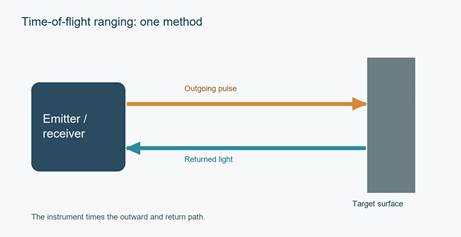
The pulse leaves the emitter. A detector receives some of the light returned by the target. Timing the outward trip and the trip back gives a time-of-flight system its distance input. The arithmetic happens in the instrument, but the operator still chooses the surface. If that surface gives a weak return, a trial may yield no reading. Other ranging methods exist; ask what the proposed unit actually uses before treating this explanation as its operating description. The product family alone cannot answer that question.
Read the number alongside a note of the aim point. Take a second reading from the same position. If it changes, look at the scene before blaming the device. The aim may have crossed the sign’s edge; the operator may have shifted, or a branch may have entered the path. Write down the change. Decimal places on a display cannot identify the surface that returned the light.
Laser-scanner experiments have examined distance, target color, angle, and reflectivity. The tested scanner is not the handheld sample under review. Still, those variables offer a useful way to label trial conditions. Note them beside each reading rather than turning someone else’s test result into a promise about this device.
If the job includes a pale panel and a dark, textured one, try both at the same position. Record finish as well as color. Turn a surface only if the job includes angled targets. A note reading “failed at distance” is nearly useless when the target changed between attempts. Name the change, then give the supplier the two observations.
| Test condition | Record before each reading | Why it matters to the buyer |
| Target | Material, color, size, and marked point | Shows what was actually measured |
| Geometry | Distance and approximate surface angle | Makes repeated checks comparable |
| Scene | Foreground objects and background | Helps identify an unintended return |
| Environment | Light and visible weather conditions | Keeps sample results in context |
| Handling | Support, stance, and aiming method | Separates use from device behavior |
Before testing, mark the rows that reflect routine work. If a rare target is critical, give it a separate trial. Do not let an easy indoor reading stand for that case.
With a fence or branch in front of a target, a short reading deserves a second look. Was the beam on the intended surface? Move the aim deliberately and note when the value changes. The result does not diagnose the instrument by itself. It tells the buyer where to repeat the trial and what to ask about any modes offered on the proposed configuration.
Mark the target and the operator’s position. The next tester can return to the same scene. Readings on one surface belong together.
Choose the surface the operator normally faces. If the purchase depends on accuracy, measure its distance by an appropriate separate method and record that reference beside the sample’s output. Do not change the operator’s position halfway through the first set. A darker or smaller second target belongs in another set, labeled as a different case.
Leave the target in place for the first series. Record every reading, including a blank display or error. For the next series, change one thing: angle, foreground, or support. Changing all three would hide the cause of a difference. These observations help frame a supplier question; they are not a certified accuracy test.
Keep the two series apart. Similar numbers show repeatability under that setup, not closeness to the actual distance. For a stated error limit, use the separate reference and request evidence for the exact configuration.
Keep a compact record for each trial:
State target type, normal and difficult distances, and how the reading will be used. Mention whether the operator stays put or moves. Ask for the proposed configuration’s measurement method and controls.
Describe the task: a fixed structure from a clear position, or a small target behind objects. Include measurement frequency and what makes a result unusable. Ask which claims need a separate report.
Agree on the target before distributing a sample. Record returned and missing readings, then check the controls. For a formal accuracy requirement, request evidence for that configuration.
Pair each observation with its condition. A short reading through leaves differs from one on a clear wall. Tell the supplier what changed.
Hemusun Optical Instrument Co., Ltd. works in the research, development, manufacture, and sale of optical instruments. Its range includes rangefinders, and it offers OEM, ODM, and wholesale services. A buyer can use the optical range to identify the relevant family, then send the inquiry team a target sketch and trial sheet. That gives the supplier something specific to answer: which available configuration matches the scene, and which product details can be checked on a sample?
A rangefinder reading becomes useful when it carries a target label and a test condition. Confirm the proposed method, mark the surface, and repeat the task on the kinds of targets the unit will face. When a result changes, keep the scene description with it. A supplier can answer a question about a specific surface and position far more readily than one about an unexplained number.
The method and trial conditions raise three common questions.
For a time-of-flight design, a pulse travels to the target and a detector receives returned light. The elapsed round-trip time feeds the distance calculation. That answers “how does a laser rangefinder work?” for this method. Ask whether the proposed unit uses it; the product category alone does not settle the question.
They can. A dark, textured face or a steeply angled surface may give a different return from a pale flat panel. Put the surface and angle beside the reading. A result reported for a research scanner does not set the performance of the handheld sample on the buyer’s desk.
Mark a representative target and the operator’s position. Request the proposed measurement method, then repeat readings on the surfaces used in the job. If a stated accuracy limit is part of the purchase, ask for evidence covering that configuration and the actual conditions of its specific test.