
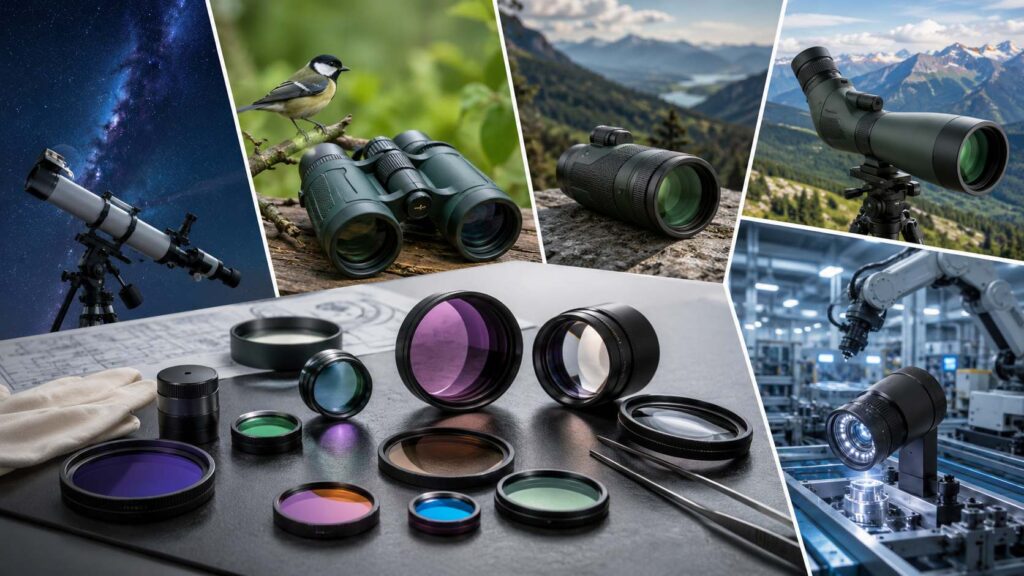
A bright planet against a dark sky, a white bird beside deep green leaves, or a distant ridge in hard afternoon light can expose a telescope’s limits quickly. Standard optical glass may deliver a useful view, yet color fringes often appear around high-contrast edges. At higher magnification, those fringes can soften detail and make focusing less certain.
That explains why the ED glass scope has transitioned from a niche product to a popular one. The rising popularity of astronomy, bird watching, wildlife spotting, and digiscoping has altered consumer expectations. In addition to magnification, clear color reproduction and crisp edge definition are more important than ever.
ED means extra-low dispersion. It describes optical glass made to control how strongly different wavelengths of visible light separate as they pass through a lens.
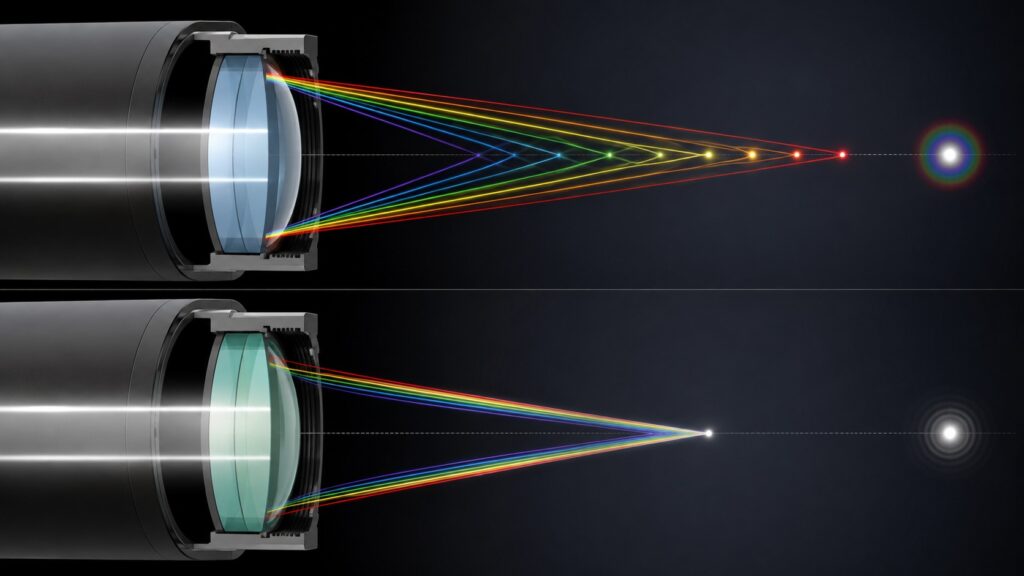
A lens refracts blue, green, and red wavelengths by different degrees. The problem with the optical glass telescope is that the wavelengths do not converge in one focus. Thus, there appears to be chromatic aberration in the form of purplish, bluish or green edges on the images of the Moon, bright stars, birds, tree branches, street signs and other shiny objects.
The achromat lens brings two portions of the spectrum closer together; however, there will be residual color to some extent, especially in short refractors and high magnification.
An ED lens helps more wavelengths reach a tighter common focus. When the design, polishing, alignment, and coatings are also well executed, the benefits may include:
ED glass cannot overcome aperture, poor air, or excessive distance. It removes one important source of image degradation.
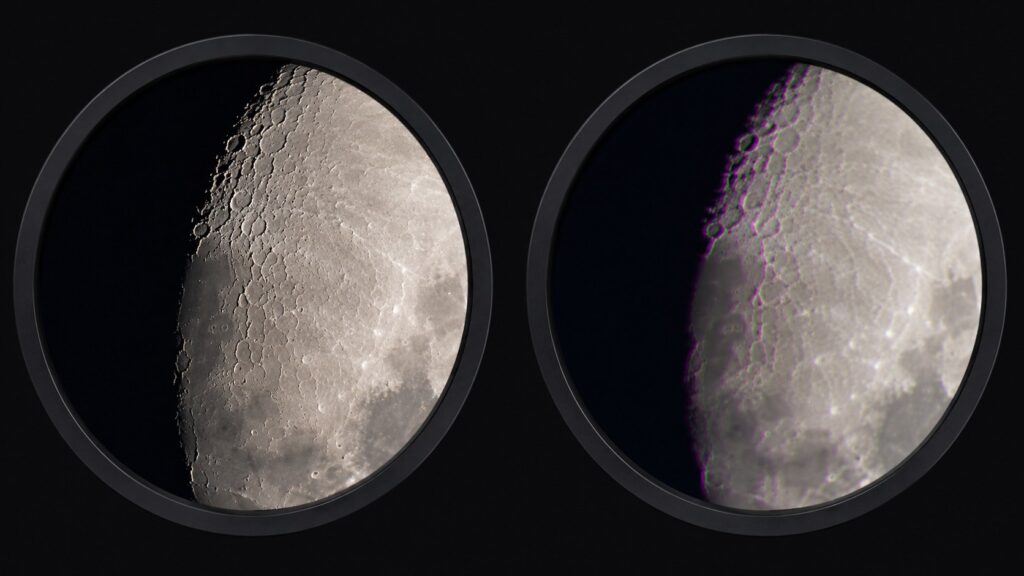
The difference is easiest to see in demanding conditions. A low-contrast landscape on an overcast day may look acceptable through both systems. A bright lunar edge, backlit bird, reflective waterline, or dark branch against pale sky is more revealing.
| Viewing factor | ED glass telescope | Standard optical glass telescope |
| Color correction | Better control of secondary color | More visible color fringing |
| High-contrast edges | Cleaner and more neutral | Colored outlines may appear |
| High magnification | Detail often stays easier to read | Softness becomes more obvious |
| Photography | Better color consistency | More correction may be needed |
| Cost | Usually higher | Usually lower |
| Best fit | Serious observation and imaging | Casual or budget-led use |
These are typical results, not a guarantee. A poorly designed ED telescope can perform worse than a carefully made standard-glass instrument. Surface accuracy, coatings, baffling, alignment, and inspection also affect optical performance.
The shift reflects modern use. Many buyers expect one instrument to handle wildlife, astronomy, landscapes, and camera-based work.
High-resolution screens and camera adapters make optical flaws easier to spot. A fringe that seems minor to the eye can look obvious in a photograph. During birdwatching, color error may hide feather markings on distant or backlit subjects.
For astronomy, false color around the Moon, bright planets, and stars can reduce perceived sharpness. An ED refractor telescope produces a more neutral view and is especially useful for lunar, planetary, and wide-field observation.
A long focal ratio helps in using ordinary glass to reduce chromatic aberration, but a long tube is more difficult to carry and mount. Using extra-low dispersion glass allows more design freedom for making short and light telescopes with good color correction.
This becomes important for people who travel, watch birds, and hobbyist astronomers. Shorter ED telescopes can strike a good balance between portability and image quality without requiring huge mounting devices.
A camera records defects the eye may ignore. Purple fringing, soft star shapes, and uneven color become part of the file. Software can reduce some effects, but it cannot fully restore detail that was never focused cleanly.
For digiscoping, an ED spotting scope can improve feather detail. For astrophotography, an ED lens can produce tighter-looking stars, although tracking, focus, field curvature, and sensor position still matter.
The answer depends on the subject, magnification, and frequency of use. ED glass is most valuable when color accuracy and fine detail matter more than the lowest purchase price.
It is often a sensible choice for:
Standard optical glass remains practical for occasional landscape viewing, basic astronomy, classroom use, or strict budgets. The upgrade is easier to justify when the instrument will be used often, photographed through, or expected to work in harsh contrast.
The ED label should begin the evaluation, not end it. A strong optical system combines suitable glass with sound engineering and consistent production.
Review aperture, focal length, field of view, eye relief, coatings, weather protection, and mounting options. Larger aperture gathers more light but adds weight. Extreme magnification claims matter less than a clear, stable image.
For a spotting scope, smooth focusing and a rigid tripod connection matter every day. For an astronomy telescope, the mount and focuser may influence the experience as much as the objective lens.
Commercial buyers, distributors, and private-label customers should request details that match the intended market:
Clear answers reveal more than an ED badge and reduce performance risk.
ED technology works across several product groups. ED spotting scopes suit birdwatching, long-distance viewing, and digiscoping. ED binoculars offer portable viewing with improved color control. Astronomy refractors give cleaner views of bright celestial objects. Custom optical lenses can serve imaging, environmental, medical, and industrial systems.
The right choice depends on working distance, field of view, available light, target size, and acceptable weight. Matching the design to the task usually beats choosing the largest objective or highest magnification.
Hemusun Optical Instrument Co., Ltd is an optic product provider that renders R&D, manufacture, OEM, ODM, wholesale, and customizing service. The product lines include telescopes, spotting scopes, binoculars, monoculars, lenses, filters, rangefinding optics, night vision, microscopes, and optic components.
The custom manufacture includes grinding, polishing, coating, cementing, cleaning, assembling, inspecting and testing. Such an approach is well-suited for the development of brands and distribution of companies that require their optics, housings, accessories, packaging and positioning to be designed as one single project. Precision lens processing also supports non-consumer applications.
ED glass is becoming popular because customers realize its advantages under tough conditions. Better handling of chromatic aberration leads to enhanced colors, sharper edges, and increased utility of magnification. The advantage becomes particularly evident in astronomy, birding, wildlife viewing, digiscoping, and in miniature optical constructions.
The use of ED glass does not suffice on its own. The finest telescope is one that combines the right materials and optimal shaping, along with proper coatings, alignment, mechanics, and control. A comparative analysis of the entire system is the way to go for field reliability.
ED means extra-low dispersion. An ED lens reduces the separation of light wavelengths, helping them focus more closely together and lowering visible chromatic aberration.
Usually, ED glass will provide better color correction if the telescope is properly designed. However, ordinary optical glass will work fine for casual observations, although there is a risk of getting some fringing on bright and contrasting objects.
Yes. Using an ED spotting scope or binoculars will help to see more natural colors and more feather details of a bird even at large distances, backlighting, or on a bright background of water or sky.
Check coatings, aperture, field of view, focusing, mechanical stability, weather sealing, alignment, accessories, inspection standards, and suitability for the intended viewing enviroment.