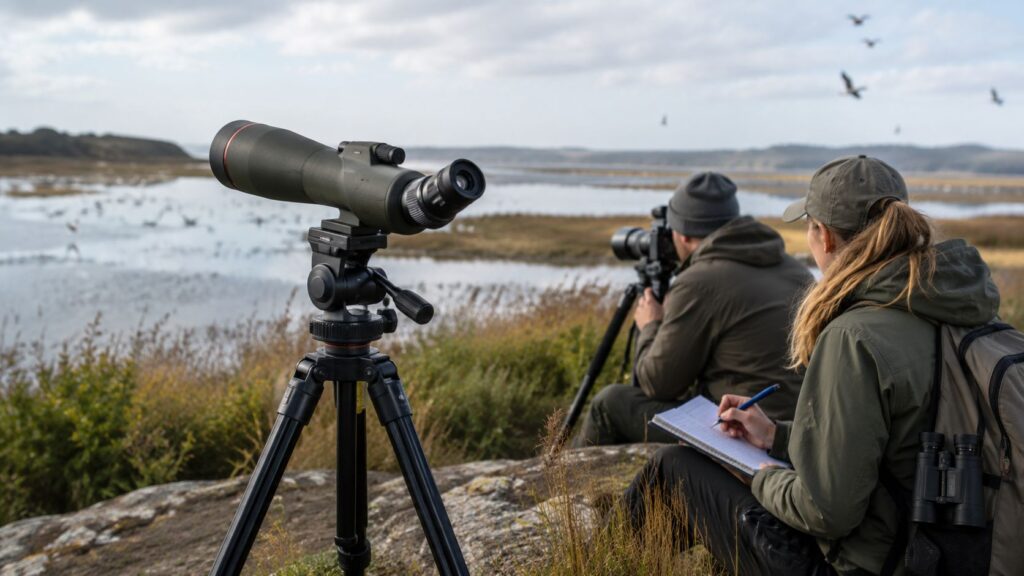
A professional spotting scope must reveal useful detail, stay steady, focus quickly, and remain comfortable during wildlife photography, bird surveys, environmental monitoring, and scientific fieldwork.
The right choice starts with the task. Photographers may care most about chromatic aberration, stability, and camera alignment. Researchers may place greater weight on field of view, eye relief, weather sealing, and repeatable focusing. Learning how to choose a spotting scope starts with practical image quality, not the largest zoom number.
Before comparing specifications, define distance, subject movement, light level, carrying time, and recording method. A hiking scope has a different job from an instrument at a fixed wetland station.
A digiscoping spotting scope works with a smartphone or camera. It records weaknesses the eye may overlook, including color fringing, soft edges, glare, and vibration.
Lower power is best for locating and framing wildlife. Magnification can then be increased for markings or behavior. A rigid adapter and balanced tripod are essential at 40x or 60x.
A spotting scope for scientific research must support consistent observations. During a bird count, researchers may scan a shoreline for hours. A narrow field or stiff focus control slows the work and adds fatigue.
Useful field questions include:
Magnification, objective size, glass, coatings, field of view, and mechanical design work as one system.
A practical spotting scope buying guide should begin with common 15–45x and 20–60x zoom ranges. Lower power gives a wider field, brighter image, and faster target finding. Higher power shows smaller details, but it also magnifies heat shimmer, wind movement, focusing errors, and tripod vibration.
Rising warm air can soften a distant image, so 30x may show more usable detail than 60x. Maximum power is an option, not the normal working setting.
A 65 mm class scope is easier to carry and set up. An 80–100 mm objective can provide stronger low-light performance, but it adds weight and needs firmer support.
Exit pupil offers a quick brightness comparison: divide objective diameter by magnification. A 60 mm scope at 60x has a 1 mm exit pupil, while a 100 mm scope at 60x has about 1.7 mm. The larger value is generally easier on the eye in weak light, though coatings and optical quality still matter.
The table provides a simple spotting scope comparison for common assignments.
| Field requirement | Useful scope characteristics |
| Long hikes | Compact body, moderate objective, wide field |
| Dawn or dusk work | Larger objective, efficient coatings, stable support |
| Digiscoping | ED glass, precise focus, rigid adapter |
| Group research | Angled viewing, long eye relief, rotating collar |
| Moving wildlife | Wide field, smooth zoom, fast coarse focus |
An ED spotting scope uses extra-low dispersion glass to reduce color focus errors around branches, white plumage, reflective water, or dark subjects against snow.
Reduced chromatic aberration makes color details easier to judge and limits colored borders in cropped photographs. ED glass remains valuable for high-magnification imaging.
Fully multi-coated surfaces reduce reflections. In suitable prism systems, phase coating can support sharper detail, while dielectric coating can improve reflectivity and contrast. Coating names alone do not prove quality; check brightness, glare, color balance, and resolution outdoors.
A wide field of view makes it easier to find a moving bird, follow an animal, or scan a survey area. As magnification rises, the field normally becomes narrower.
Long eye relief matters for observers who wear glasses and for long sessions. The full image should remain visible without pressing the eye against the eyecup. Edge-to-edge clarity is also important because blurred edges slow systematic scanning. Angled eyepieces suit shared or prolonged observation, while straight designs can make rapid target alignment easier.
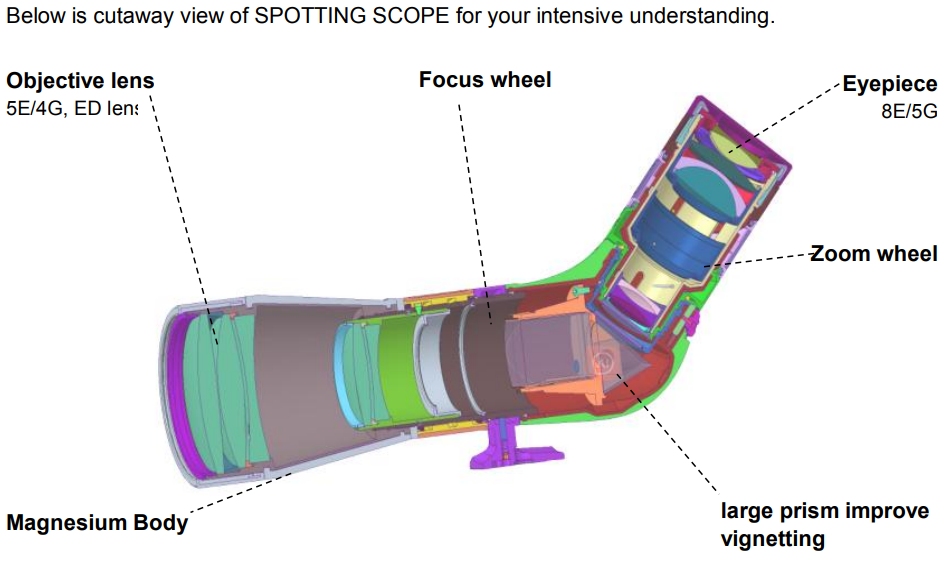
Fine optics cannot deliver their full value through an unstable or awkward body. High magnification turns small mechanical problems into visible movement.
Single focus systems suit general viewing, while dual-speed focusing separates coarse and fine control. Coarse focus moves quickly between distances. Fine focus makes small corrections at high power without repeatedly passing the sharpest point.
For professional spotting scope photography, the control should move smoothly with little backlash. For research, it should feel consistent across repeated use and temperature changes.
The tripod must carry the scope, head, camera, and adapter without flexing. A smooth pan-and-tilt head helps track wildlife.
Avoid raising the center column unless needed. A lower, wider stance usually cuts vibration. On soft ground, set the legs firmly. For digiscoping, use a timer or remote release to reduce contact.
A waterproof and fogproof spotting scope is valuable around wetlands, coasts, mountains, and cold-weather sites. Sealing blocks rain and dust, while dry-gas filling can reduce internal condensation.
Durability also includes secure lens caps, a protective exterior, firm eyepiece fittings, and controls that survive repeated transport.
Test outdoors using printed text, fine branches, dark and bright objects, and a moving subject at several distances.
A 20-minute test should cover:
For research procurement, several observers should score the same sample to reduce the effect of personal eyesight.
Hemusun Optical Instrument Co., Ltd. is high quality optical products supplier engaged in research, development, production and worldwide sales. The products are including spotting scopes, binoculars, monoculars, telescopes, rangefinders, night visions, filters, lenses and other optical components.
Types of business include finished goods and OEM/ ODM projects, incorporating grinding, polishing, coating, cleaning, assembly of lenses and bespoke manufacturing. Precision specification inspection and systematic quality control endorse outdoor observation, climate monitoring, scientific research and industrial installations. Buyers may request catalogues, custom specifications, private-label options, or technical discussions.
The best spotting scope is the one that produces reliable detail in real working conditions. Photography calls for clean color, precise focus, stable mounting, and sound camera alignment. Scientific work adds repeatable results, viewing comfort, weather resistance, and easy operation by several observers.
Choose the application first, then compare magnification, objective lens size, ED glass, field of view, eye relief, focusing, and tripod stability as one system. A field test provides more value than choosing by maximum zoom alone.
A 15–45x or 20–60x range gives useful flexibility. Lower power is better for finding and framing a subject. Higher power can record fine detail when the air is steady and the tripod is rigid.
It is not mandatory, but ED glass is useful because camera sensors and image crops make color fringing easier to see. It is especially valuable for high-contrast scenes.
No. A larger objective can improve low-light performance and provide a larger exit pupil, but it also increases weight and tripod demands. A smaller scope may suit hiking, rapid surveys, and frequent relocation better.
Look for repeatable focusing, a clear field from center to edge, long eye relief, weather protection, stable mounting, and controls that several users can operate consistently.
Yes. An experienced optical products supplier may offer custom optics, coatings, housings, accessories, packaging, and private-label services. State the target distance, lighting, environmental conditions, mounting method, imaging device, and inspection standards.