
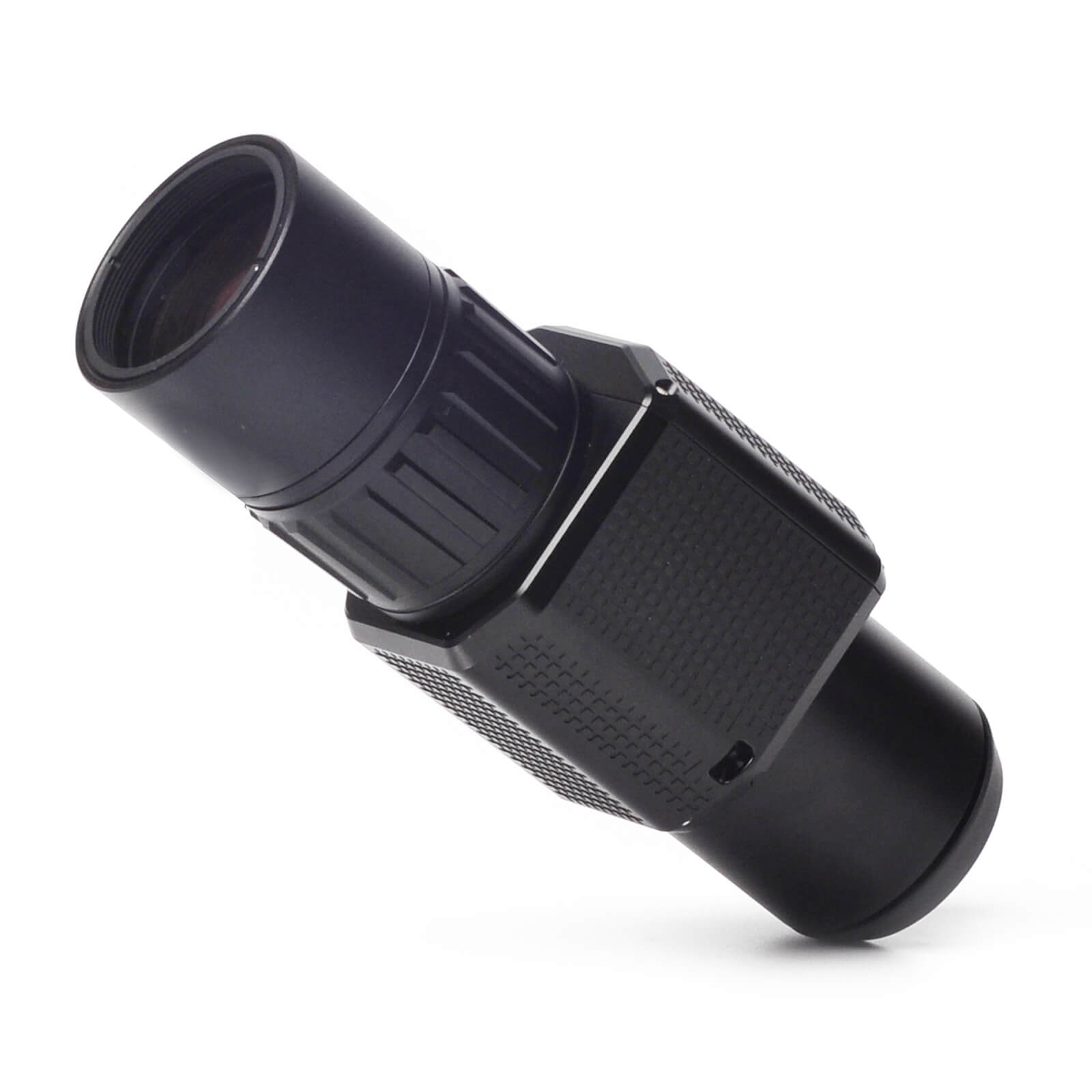
Handheld optics above 10x carry one constant problem: the image drifts even when the target is still. The 12x33 anti-shake phone lens and monocular 2-in-1 is built to remove that drift at the source. That correction chain — gyroscope, smart control loop, near-focus stabilized image — is where the value of the product sits, and it is also what distributors and OEM buyers should verify before placing an order.
The Anti-Shake Cell Phone Lens / Monocular 2-in-1 12x33 (Givite reference model GVQE-12x33) pairs a gyroscope with a smart control loop to hold the image steady at the full 12x, where an unstabilized hand gives up.
A small angular drift at the hand becomes a large drift in the image. At 10x a half-degree wobble is barely noticeable; at 12x the same wobble sweeps noticeably across the field, and the observer has to keep re-centering. That re-centering is what makes high-magnification handheld work tiring, and it is the problem stabilization is meant to solve.
A stabilized instrument addresses this with a closed loop. A gyroscope reads the motion of the body in real time, a control algorithm turns that reading into a correction signal, and a correction stage applies the opposite movement to the optical path. The body keeps moving in your hand, but the light path is nudged back, so the picture holds still.
Most stabilized optics are designed for distant targets. The 12x33 is different: it pairs a compact prism group with a stabilized unit that still works at near focus. That is the near-focus stabilized image architecture, and it is what lets the same body do two jobs. As a standalone instrument it is a 12x stabilized monocular for the field. Mounted on a phone through its telephoto adapter it becomes an optically stabilized telephoto lens, so the correction loop steadies both the direct view and the camera capture.
The compact prism group is the practical reason this works in a small body. Because the optics are folded into a short train, the stabilization unit stays small enough to fit a phone sleeve while still carrying the gyroscope and control electronics. For a buyer, the value is in that combination: one device that covers handheld observation and phone photography without a second unit.
The use cases are the ones where the observer is moving and the target is distant: handheld observation, vehicle and boat work, outdoor events, birding, search and rescue, industrial observation, and security. In each of these the operator is rarely set up on a tripod, which is exactly where a sensor loop adds the most value. For a distributor, the product is also a proof point: it demonstrates the stabilization architecture at a form factor and price that end customers accept.
If a stabilized configuration of your own is the goal, the custom devices and products page shows what can be adapted, from the prism group to the enclosure.
The parameters that decide whether the unit fits your market are the stabilization behavior and the optics that carry it. Check the stabilization against real motion, not a bench test: a gyroscope that reads correctly on a tripod can still drift after hours of handheld use. Check the optical specification next: magnification, the prism group, and the coating that protects contrast at the high end. Then check the practical items: weight, battery runtime, and whether the phone adapter is included, because a stabilized unit that runs down quickly is a returns problem, not a feature.
From a buyer's point of view, it is also worth understanding how the correction is delivered. Some instruments stabilize the sensor or the display signal, which keeps the captured image steady but does not steady the view you see through the eyepiece. The 12x33 corrects the optical path, so both the direct view and the phone capture are held steady by the same loop. That distinction matters when the operator is switching between looking through the unit and recording through the phone, because the same correction is doing the work in both modes.
Battery behavior is the second practical check. A stabilization loop runs continuously, so the unit draws power while the image is held steady, and the run time under active stabilization is shorter than under idle viewing. For a buyer, that means asking how long the battery holds a session of active use and whether the battery is replaceable in the field. A stabilized unit that holds a full day of work is a feature; one that runs down in the morning is a reason to rethink the use case.
Hemusun is a dedicated optical instruments manufacturer covering research, development, manufacturing and sales, with OEM, ODM and custom design services. Production runs through optical processing and coating, with inspection and testing at each stage, backed by warranty, repair and technical support after delivery. The company holds ISO and CE certificates together with a software copyright patent, an independent appearance patent, and a utility model patent.
The typical sequence for a stabilized program: define the target market and use case, agree the exact specification, order a sample run, verify it against the data sheet, then move to volume. Payment terms include T/T, L/C, D/P, D/A, credit card, PayPal and Western Union. MOQ varies by product; please contact us for details for your specific configuration.
The 12x33 2-in-1 shows what a closed stabilization loop does in a handheld body: a steadier image at 12x, less observer fatigue, and a phone attachment for documentation. If you are buying an anti-shake 2-in-1 for your market, pin the use case first, verify the stabilization against real motion second, and start with a sample run before committing volume.
For specifications, samples, and OEM quotes on the stabilized 2-in-1 line, contact Hemusun at support@hemusun.com, or by WeChat and WhatsApp.
The gyroscope reads the motion of the body in real time, a smart control algorithm turns that reading into a correction signal, and a correction stage applies the opposite movement to the optical path so the picture holds still while your hand keeps moving.
It is the design that lets the stabilized unit work at near focus as well as at distance, which is what allows the same 12x33 body to serve as a standalone monocular and as a phone telephoto lens.
Yes. Mounted through its telephoto adapter the unit acts as an optically stabilized telephoto lens, and the correction loop steadies the camera capture as well as the direct view.
MOQ varies by product and by configuration; please contact us for details for your specific requirement rather than relying on a single general figure.