
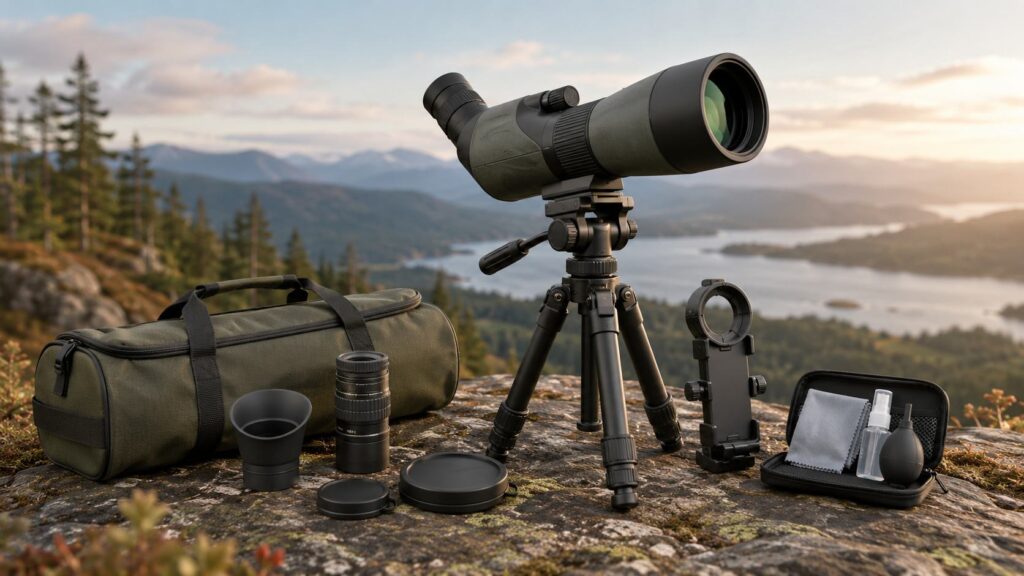
A spotting scope is primarily a long distance viewing instrument and it will reveal all of the weaknesses in a viewing setup. While a small amount of shake may be annoying at 20x, it can immediately turn a bird, target, ridge line or even a distant boat into a confusing blur at 45x or 60x. In this article we will outline all of the main spotting scope accessories which, while they are often considered optional, can greatly enhance the use of your scope in the field. A good quality tripod, a suitable eyepiece, comfortable eye cup, scope case, lens caps, phone adapter and cleaning accessories all play important roles in the overall performance of the scope.
The best accessories to complement a spotting scope are those that solve real field problems to you the user, such as: Image shake, Eye fatigue, Slow set up, Damaged glass, Wet weather, Dust, and Poor phone connectivity. We will cover the best bird watching, hunting, target shooting, wildlife viewing, travel, and long distance observation accessories on the market.
Optics are only as good as the support provided to them. A bright, sharp and compact spotting scope can quickly become disappointing if the tripod is inadequate, the eyecup does not fit into the user’s eye position or if the front lens of the spotting scope is exposed to the elements in harsh weather.
By including some additional accessories to your photography equipment, a well balanced setup of accessories can improve the stability, comfort, protection and flexibility of your photography. A better spotting scope tripod or tripod head is usually one of the first upgrades for many users. Additional accessories like eyepieces, eyecups, covers and adapters for your spotting scope can then be used to fine-tune your setup.
A spotting scope tripod is the most important piece of equipment for obtaining sharp images with a spotting scope. A spotting scope is simply too powerful to use for extended periods of time when handholding, even when the subject is far away. Gently swaying from a light breeze, an uneven surface or simply stiffness when turning the focusing ring can all very quickly degrade the image.
A good tripod to use with a scope will be of a size that is roughly equivalent to the scope itself plus viewing height plus field conditions. A compact travel tripod may be fine for a light angled scope on a day hike but a larger straight scope that is used for target shooting or coastal observing will require a wider base of support and more load bearing capability.
Check these details before buying:
Our Carbon Fiber Series of tripods are lightweight and offer superior vibration reduction making them ideal for the serious birder and also for the traveling photographer. Our Aluminum Series are more cost effective and have a solid feel to them especially in windy conditions.
The tripod head controls how smooth the scope moves. A good pan-tilt head is ideal for slow, deliberate, left-right and up-down panning that is required for reading the details of target holes or searching a long shoreline. A fluid head is smooth for following fast moving objects such as birds, deer, boats or aircraft. A ball head is quick to move but often too sensitive for fine tuning at high magnification.
A quick release plate is worth having. It lets the user remove the scope for packing, switch devices, or move from a tripod to a window mount without wasting time.
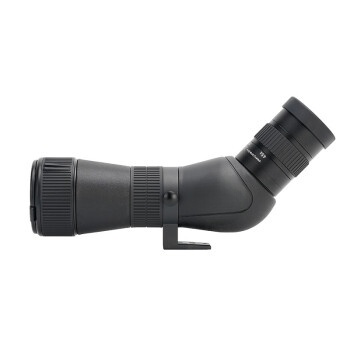
The eyepiece of the spotting scope controls the magnification, the field of view and the feeling when viewing. This in turn determines how fast objects can be found and how much detail one can see of the object that is centered in the field of view.
Most users opt for a zoom eyepiece as it allows the user to shoot over various distances. Lower magnification powers enable the user to see where the bird has flown to in reeds or where the target has been moved on a busy range. Higher magnification powers allow the user to see feather detail, antler detail, bullet holes and other markings on long range targets. Most users require a moderate level of magnification and a 15–45x or 20–60x zoom eyepiece is typically sufficient.
The benefit of a fixed focal length for an eyepiece is that it produces a crisp, bright image at set viewing distances. The large field of view of a wide-angle eyepiece enables quick tracking of subjects in motion, or of searching wide open spaces. Often, the largest numerical value printed on the barrel of an eyepiece does not translate into the best performance under working conditions, which are so frequently affected by such things as heat haze, poor light, wind and subject movement. The effective magnification that can be realized in these circumstances is not necessarily as large as the labeled value.
The spotting scope eyecup looks very simple, yet it can make a big difference to how comfortable viewing is, particularly over long periods. The purpose of the eyecup is to ensure the eye is the correct distance from the ocular lens. This distance is referred to as eye relief.
For people who wear glasses, a fold-down or twist-down eyecup provides the best full-frame viewing experience. Without this feature, the viewer may experience a dark or cut-off image on one side of the frame. For people without glasses, a raised eyecup feature prevents side light from entering the viewer and helps to keep the eye properly positioned in the viewer.
For the bird watchers, range officers, guides and others who share the scope with others, having long eye relief is good. When the scope’s eyecup and eye relief are set properly to your eyes, you are able to perceive action more quickly and less fatigue is perceived.
Since we spend most of our time with our outdoor optics in harsh environments, such as dusty trails, rainy weather, bumpy backpack paths, rusty truck beds, salt-laden air, and chilly pre-dawn hours, it’s safe to say that a spotting scope protective case will primarily serve to protect the items noted above that can affect a scope’s performance by preserving the pre-fielded collimation, protective coatings, finish, and glass surfaces.
| Accessory | Main Use | Best For |
| Protective case | Transport and storage | Travel, shipping, field kits |
| Stay-on cover | Body protection while viewing | Hunting, birding, rough trails |
| Objective lens cap | Front lens protection | Dust, scratches, rain spots |
| Eyepiece cap | Ocular lens protection | Packing and storage |
| Rain cover | Wet weather protection | Marshes, forests, coastlines |
| Carrying strap | Faster movement between sites | Birding walks and outdoor events |
A stay-on spotting scope cover is a useful thing to carry with you into rough country. It can protect your scope from scratches and bumps, yet allow you to access the focus wheel and the tripod mount. In the mean time, make sure to put your lens caps on the scope when you are not using it.
A spotting scope phone adapter allows you to record what you see with your spotting scope. Whether you are a bird watcher documenting a rare sighting, a shooter checking the groupings from your last shot, or a traveler capturing images of distant landmarks while on the go, a spotting scope phone adapter is a simple idea that requires careful alignment to work well.
Place the front of the phone lens directly over the eyepiece end of the telescope. If the lens is not in the center the image may display black rings, softness at the edges or uneven brightness. A good digiscoping adapter should hold the phone firmly in place, allow for small changes in position and then lock into place. Mark the position of the phone on the adapter for future use.
For cleaning a spotting scope you will need a spotting scope cleaning kit. This typically consists of a blower, a soft brush, a microfiber cloth and a cleaning solution. First remove any loose dirt with the blower or brush and then wipe clean with a microfiber cloth. Try to avoid dragging any sand or hard dirt across the glass as this can leave fine scratches on the coating.
A sunshade will help to reduce glare in low sun conditions and also when viewing over water, snow or pale sand. A dew shield is particularly useful on those damp mornings when the temperature is low but shooting is to take place in warmer conditions. While waterproof and fogproof construction is important to the user’s ability to use their binoculars in the worst of weather, good habits on the part of the user are also required. The outside of the binoculars should be dried before storage, the case left open after use in the wet, and gear not sealed in a damp state left open in a bag overnight rather than being left compressed overnight.
There are different users that need different sets of accessories to complete their outfit. A birder walking three miles for example will require a very different kit to a shooter shooting from a static bench.
For bird watching a very lightweight tripod, a fluid head, a wide angle or zoom eyepiece, a phone adapter and a cleaning cloth is sufficient. For hunting a stay-on cover, a compact tripod, a rain cover, a lens cap and a carrying case is more important. For target shooting a heavy-duty tripod, a pan-tilt head, a zoom eyepiece and a quick release plate is required. For travel a simple setup is recommended, e.g. a compact tripod, a padded case, an eyepiece cap and a small cleaning kit.
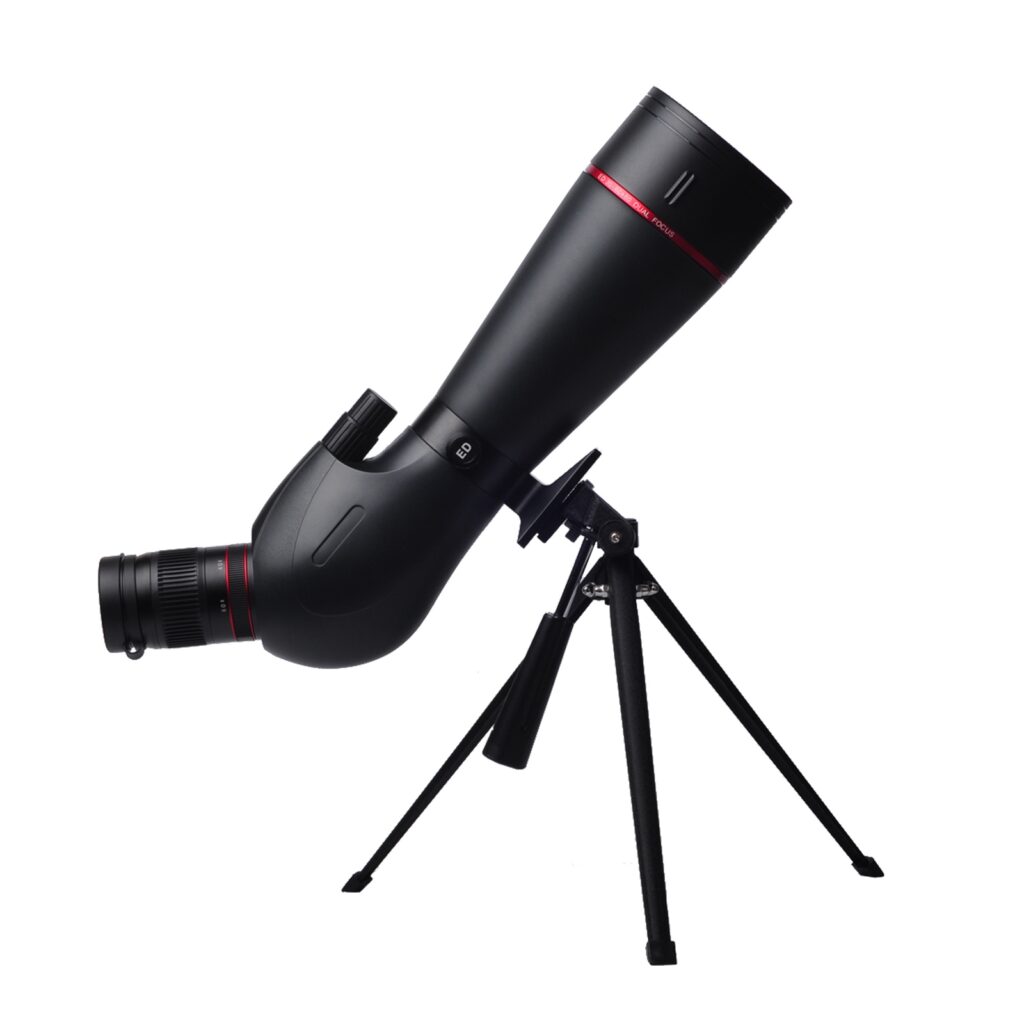
Hemusun Optical Instrument Co., Ltd. is a supplier of high-quality optical products for research, development, production and sales of optical instruments. Their product range includes spotting scopes, binoculars, monoculars, rangefinders, night vision, astronomical telescopes, lenses and filters for various applications, microscopes, magnifying glasses and other custom optical components.
The value for the buyer is not just in the variety of products that Hemusun offers. It also supports OEM / ODM / wholesale / retail / customized optical solutions. The work of Hemusun includes optical design, selecting raw materials, grinding, polishing, coating, assembling, checking for quality and packaging. It is important to note that the value of accessories, how a tripod is mounted, the comfort of an eyepiece, the quality of the coating and the mechanical consistency of the product all affect the overall user experience of the product.
These accessories for spotting scopes can make a strong scope even stronger, and of course also more useable. A good tripod for your spotting scope will deliver sharper images than holding it in your hand. A tripod head for your spotting scope that is smooth enough to follow up quickly on moving subjects is then the crowning glory. A good eyepiece in combination with a good eyecup makes viewing comfortable. A protective case, a cover for your spotting scope and several hard lens caps for the lens will protect your expensive optics between uses in a sturdy and reliable manner. Your smartphone adapter for spotting scopes and a few cleaning accessories will have real added value only if they reflect your field use habits perfectly.
In considering accessories for your spotting scope, such as those used for bird watching, hunting, target shooting, traveling, or viewing objects at a distance, keep in mind that simple is better than complicated. First and foremost, the scope must be stable and protected, then add items that enhance viewing and also serve photographers in the field. Items to consider will depend on specific uses for the scope.
High magnification can make small movement of the scope easy to detect and a spotting scope tripod is therefore recommended. A good tripod will provide a stable image and allow for longer periods of observation in comfort.
A pan-tilt head or a fluid head is generally better than a ball head. They allow for much smoother and more precise movement when scanning, tracking wildlife or even just checking your target.
A good quality eyecup for a spotting scope can help place your eye at the correct eye relief distance, aid in eye comfort, block side light and allow glasses wearers to see the full field of view.
Transport spotting scopes in a protective case, keep the caps on for the objective end and the eyepiece end when not using the scope, and also use a rain cover or stay-on cover in really wet or rugged situations.