
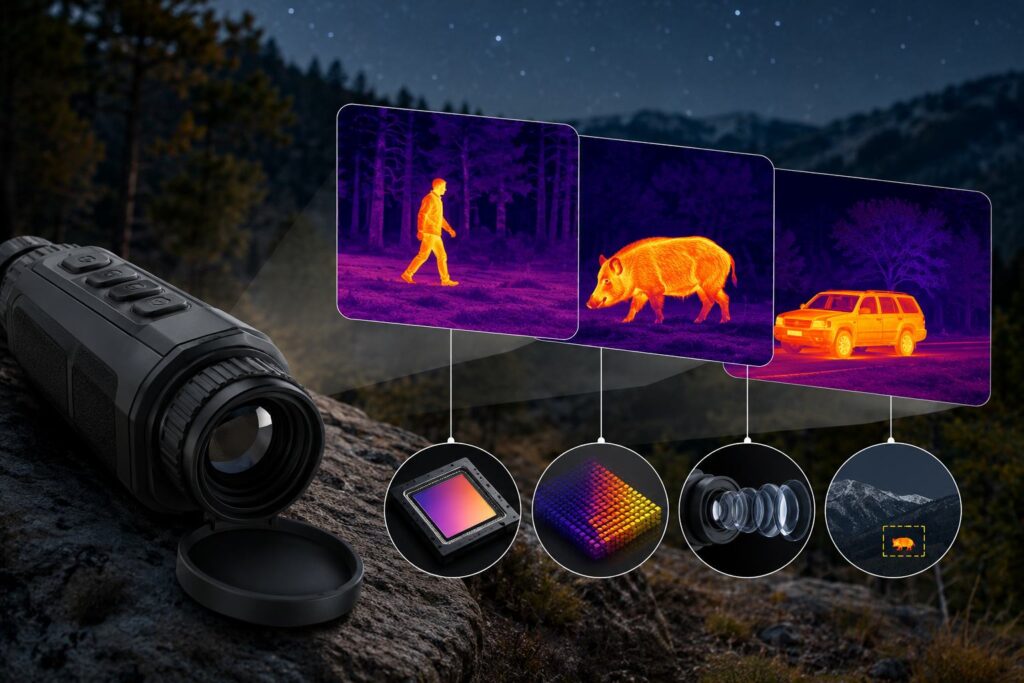
The Thermal Monocular turns a dark field, forest edge, warehouse yard or search area into a clear visible scene. However the specifications in a thermal monocular’s spec sheet carry differing weights: Thermal Monocular resolution, NETD, pixel pitch, lens size, display, battery life and detection range.
The best thermal monocular specs are not always the biggest numbers. A long detection range does not have to mean that you can identify warm targets at that range. A high-resolution sensor is not very good if it does not have enough sensitivity in rain or humid weather. A compact handheld thermal monocular can be very useful for hikers, farm owners, and even patrol officers. A long-range thermal monocular that is too heavy to carry is not very useful.
Each of the main specifications answers a different question. Read them all together rather than as a list of separate features.
| Specification | What it tells you | Why it matters |
| Resolution | Number of thermal pixels | Detail, target shape, digital zoom quality |
| NETD | Smallest temperature difference the sensor can show | Contrast in fog, rain, shade, and low-contrast scenes |
| Pixel pitch | Distance between sensor pixels, usually 12μm or 17μm | Compactness, lens design, sensitivity, and image scale |
| Detection range | Distance where a heat source can be noticed | Long-range scanning, not target identification |
Thermal monocular resolution refers to the infrared detector, not only the screen. A clear display helps comfort, but the detector decides how much thermal detail is captured first.
A 256×192 detector is good for casual outdoor observation, short-range surveillance of a property, or day hiking. It can allow you to see people, animals, cars and warm objects in complete darkness. However, as with all detectors, the detail of the target will degrade at range, and with digital zoom.
A 384×288 thermal monocular would make a very good middle of the road choice. The additional resolution would allow for even better detail of object shapes. This would be very suitable for hunting, farm patrol, law enforcement support and search missions that are conducted in open fields, along roads, around building out lines and tree lines.
A 640×512 sensor is typically used for premium long-range observation. More pixels on target yield sharper edges, more usable digital zoom and better detail to judge a heat source at distance. However, high resolution has to be balanced with other parameters. A well-made 384×288 sensor with a good lens and low NETD can provide a better image than a high-resolution sensor with poor sensitivity.
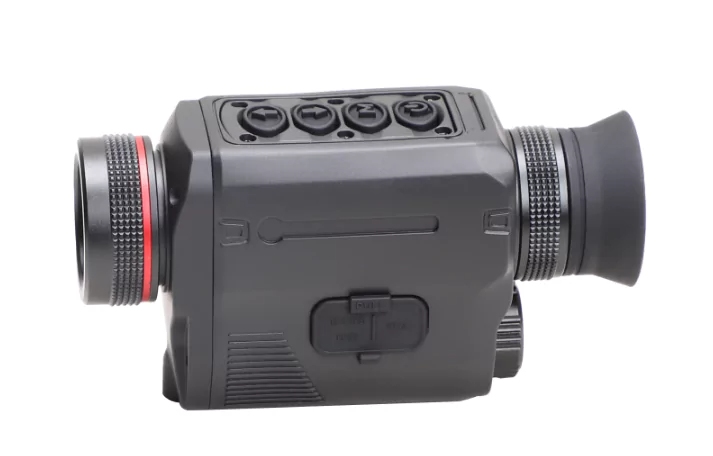
NETD, or Noise Equivalent Temperature Difference, describes thermal sensitivity. It is measured in millikelvin, shown as mK. In plain terms, NETD tells how small a temperature difference the device can separate.
A lower NETD will allow your thermal monocular to show greater contrast between targets and backgrounds of very close temperatures. This will allow you to better identify objects after a rain, near water, in fog, through heavy tree cover, or on very humid mornings.
While on a dry cold night animals and people may be strongly visible, after a warm day the temperature of soil, rocks, tree trunks and animals all decline at different rates. In low thermal contrast situations, as found in such scenes, better thermal sensitivity can be crucial to maintaining the visibility of their shapes.
Typically buyers are looking for NETD below 50mK and increasingly users are demanding 35mK or better for applications such as security patrol, search and rescue, and wildlife observation. NETD must be read in conjunction with lens aperture, calibration, image processing and display settings.
Pixel pitch is the distance between the center of a pixel and the center of the next pixel on the thermal sensor. Common values are 12μm and 17μm and it does not necessarily mean smaller is better but does affect the design of the device.
The 12μm pixel pitch enables a more compact optical system. With the same resolution, it is possible to design a very compact body and to achieve a tighter image scale with a given lens. This is ideal for portable night vision devices as well as for handheld thermal monoculars.
17μm pixel pitch typically corresponds to larger IR pixels which can collect more infrared energy per pixel and potentially enhance system sensitivity. However, this is not necessarily to say that all 17μm systems will out perform 12μm systems, since there are many factors that come into play. These include total system resolution, the lens focal length, NETD, frame rate and image processing capability.
From a distributors' perspective, the pixel pitch of a screen also determines where a product can be placed on a retailer's floor. A compact 12μm solution would be suitable for outdoor retail environments such as supermarkets whilst a 17μm solution could still be used for professional applications, where the use of stable optics and high thermal sensitivity are key.
One of the more misunderstood thermal monocular specifications is the thermal detection range of objects in the field. In reading many online specifications, for example a thermal monocular that can see out to 1,000m or 1,800m and identify objects, it is typical for consumers to believe that if an object emits heat and the thermal imager is within the specified detection range that the object will be clearly identifiable to the user. This is not necessarily the case.
Detection of a warm object: Is something there?
Recognition means telling the general target class: Is it a person, animal, or vehicle?
Identification refers to the detail required to arrive at a judgment with regards to identification. What does this actually look like?
While a long-range thermal monocular can pick up a person across a field, recognition and identification are generally best done at closer ranges. In addition to rain and fog, branches in the line of sight, heat shimmer, the size of the target, the temperature of the background, and even simple hand shake all can decrease the useful range for recognition.
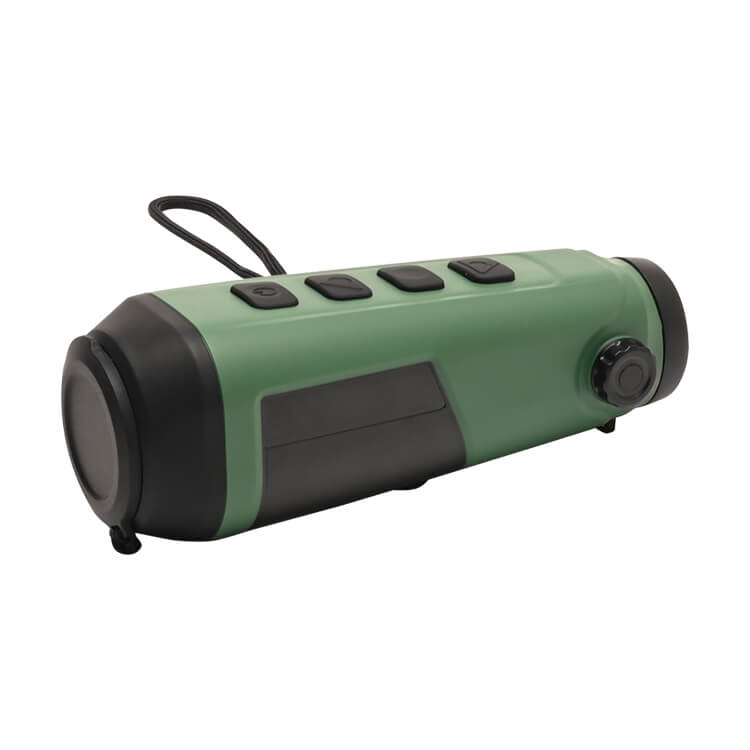
The main specs that influence my decision are: resolution, NETD, pixel pitch and detection range. There are a few secondary specs that change nothing to my daily use, though.
A longer focal length increases long distance observation but reduces the field of view. A farmer checking the entrance to his barn might need a wider field of view than a longer focal length, but a patrol team checking a ridge line above may need more reach.
I would note that a thermal monocular set to 50Hz provides for much smoother panning that you get with say a low frame rate camera. As for displays, OLED, AMOLED, and LCOS can all be good. However, it is important to note display’s brightness, contrast, as well as eye fatigue for prolonged use at night.
Battery life may matter more than extra zoom. Four to eight hours of usable running time can shape a full trip or shift. Wi-Fi hotspot, recording, Type-C connection, image palettes, heat source tracking, and IP-rated protection are practical features.
Start with the job and not with the spec sheet of a proposed supplier.
| Use case | Practical spec direction |
| Hiking and camping | Compact body, 256×192 sensor, long battery life |
| Hunting and farm security | 384×288 sensor, low NETD, 30mm-class lens, smooth refresh rate |
| Wildlife observation | Low-noise image, wide field of view, recording support |
| Search and rescue | Strong sensitivity, rugged shell, hands-free or handheld use |
| Distributor product line | Entry, mid-range, and premium tiers for different budgets |
Monoculars for hunting require fast scanning and a clear outline of animals. For security they require stable functioning in cold and humid weather around buildings, gates, warehouses, fences and vehicle yards. When buying in bulk, the business customer should also check the sample quality, the packaging, the lead time, the after-sales service and the OEM/ODM possibilities for customizing in bulk.
Hemusun Optical Instrument Co., Ltd. is a professional optical products supplier with focus on R&D, manufacturing and sales of optical instruments such as night vision, monoculars, binoculars, spotting scopes, rangefinders, telescopes, lenses, filters, magnifiers, microscopes and custom optical parts.
HENGWAL COMPANY offer their products to individual outdoor users and to business customers in OEM, ODM, wholesale and retail versions. Their night vision and thermal products range from handheld thermal monoculars to head-mounted night vision and other infrared night vision devices, thermal scopes, etc, customized for use in outdoor activities, security surveillance, hunting, hiking, for law enforcement search support etc.
The optical component services provided by the factory include rough grinding, fine grinding, polishing, coating, gluing, black coating, cleaning and assembly. Quality check can be done by precise inspection tools and the processes are managed under ISO9001 quality system. For buyer who is building private-label night vision device, the services provided by the factory can reduce risk in purchasing from the factory, including the optical machining, product development and customization.
One simplifies choosing a thermal monocular when reading specs in context. The detail that one can see is defined by the resolution, the sensitivity by the NETD, the design of the sensor and lens by the pixel pitch. The detection range is the distance from which a heat source can be detected and not the distance from which it can be identified.
For the outdoor user, security team or the OEM buyer, a balanced solution will normally consist of a number of trade-offs between the following: Sensor resolution, Thermal sensitivity, Lens, Field of view, Refresh rate, Battery life, and Construction.
These Thermal Monocular specs will be compared to help you determine which is best for you. Sensor resolution, NETD, pixel pitch, lens size, field of view, refresh rate, battery life and detection range are all important specs to compare when looking for the best Thermal Monocular. For most people the sensor resolution, NETD and the lens design will be the main factors that determine the image quality and range that you can see with your Thermal Monocular.
Yes. A 384×288 thermal monocular is a good ‘mid-range’ piece of kit for the hunter, the farmer who wants to keep an eye on his land, the patroler and in general for all outdoor activities. It gives more detail of the target than a 256×192 but is so much more compact and affordable than the 640×512 models.
NETD means Noise Equivalent Temperature Difference. It tells how small a temperature difference the thermal sensor can display. A lower NETD value, such as around 35mK or below, usually gives better contrast in fog, rain, humidity, or low thermal contrast scenes.
No. A 12μm pixel pitch supports a very compact design and offers a sharp image scale. A 17μm pixel is larger, which may be an advantage for sensitivity in some applications. The decision for the better sensor is based on resolution, lens, NETD, software etc. depending on the application.
The thermal monocular detection range is the range at which a heat source can be detected. This is different from the recognition range and the identification range. With a larger detection range a warm target can be detected at a larger distance, but a closer distance may be required to clearly recognize the target.