
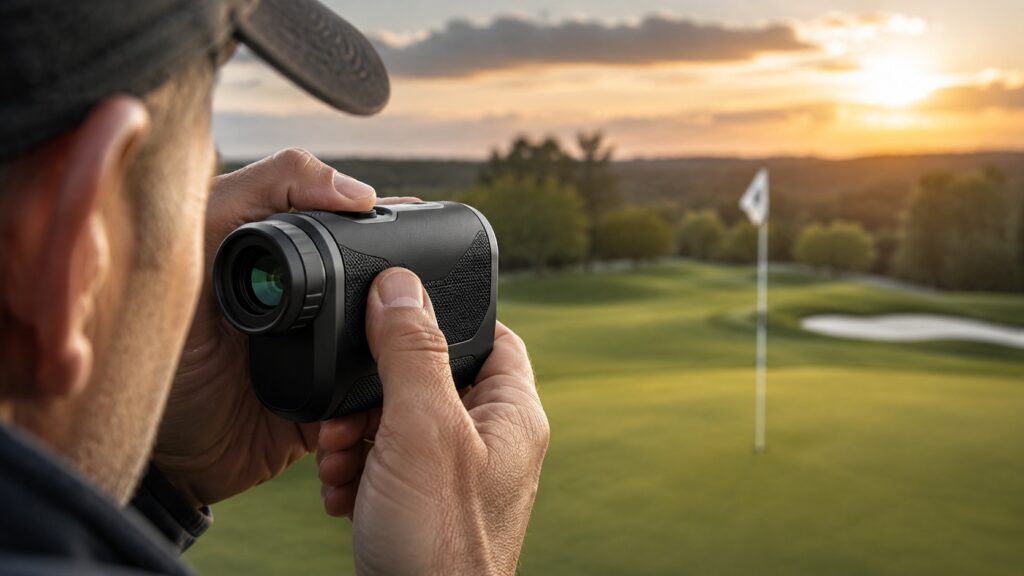
A rangefinder should provide one simple number, end of story. Yet for golfers and hunters, as well as for hikers and other outdoor workers and enthusiasts, holding steady enough to obtain a single accurate measurement can be a real challenge. The numbers jump all around on the display. A flag in the distance gets lost in the background of trees. The object to be measured is marked off against a very light background. Even the best rangefinder is of no use if the user can’t manage to hold the target for a sufficient period of time in order to get an accurate reading.
When you have shaky hands the best rangefinder for you is not necessarily the one with the longest stated range. In practical use for measuring distances the stability of a rangefinder is largely based on a few practical details: the eye relief, the magnification, the display, how quickly you can aim at the target, whether it has a vibration lock and how it feels in your hand.
Vibration lock is a wonderful feature for shooters with very shaky hands. A vibration lock rangefinder, for example, gives a short pulse or buzz of vibration when the rangefinder has locked onto the target. This tells the shooter that what they are reading off of the rangefinder is not some random background reading, it is an accurate reading of the distance to the target.
For golf, both flag lock vibration and pin lock vibration can be quite useful. A golfer might be aiming at a thin flag, sticking out from behind a tree, or from the middle of a deep bunker. Flag lock vibration or pin lock vibration can be very helpful in these situations. Say the reading for the spot the golfer is aiming at is 168 yards. Without any feedback that the device has locked in on the correct object, the golfer may assume that the reading is for the pin, or instead for a tree right behind the green. Target lock vibration will give the golfer a better sense of whether the device has locked in on the object he is intending to hit.
This same benefit also extends to hunting and other use in the field. Target lock vibration will help to lock in focus for ranging objects such as animals, rock walls, utility poles, and trail markers against a busy background. It won’t eliminate all hand movement but will help to reduce re-checks due to doubt.
Eye relief is the distance from the eyepiece end of a sight to the point in space where the eye can still view the entire image in the sight. For glasses wearers this feature can make a big difference between having a good viewing experience and a bad one. When choosing a rangefinder as a glasses wearer, it is good to check whether or not you can view the display without pressing the eyepiece against your face by the temple of your glasses.
Firstly, a poor eye relief setting can often restrict the field of view, causing the extremities to be out of focus or ‘shaded’ for want of a better word. Furthermore, users will compensate for this by tipping and turning their head – a movement that greatly exacerbates handshake. A good quality rangefinder with long eye relief teamed with a decent eyecup to suit the user’s eye, will promote a more upright viewing position, thus promoting a calm and natural aim.
Eye placement is also important for people without glasses. A soft eyecup, a solid cheek rest, and a generous viewing window all help to get the eye into position quickly.
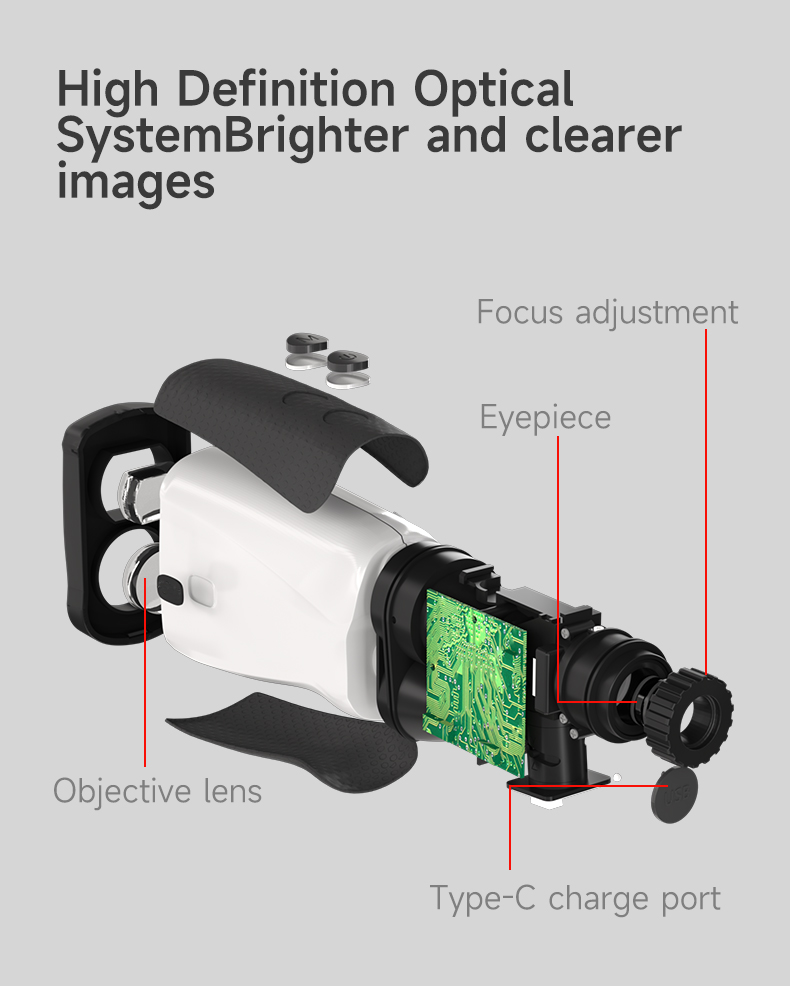
Higher magnification makes a better impression than a low magnification but it is not necessarily easier to use. A 10x magnification makes far away objects big, but every small movement of your hands looks big as well. For people with shaky hands too much magnification can make the image move too much.
For many handheld users a 6x magnification rangefinder is just right offering enough detail of flags, trees, rocks, and other markers, yet still being easily steerable to keep the image on target. A 7x magnification rangefinder offers even more detail of the target for those that require it. Above this level the level of magnification is suited for longer observation from a stable position and requires a very steady hand and high degree of technique.
| Magnification | Best Use | Stability Note |
| 6x | Golf, hunting, hiking, general outdoor measurement | Easier to hold steady for most users |
| 7x | Golf and mid-range field use | More detail, slightly more visible shake |
| 8x and above | Longer-distance viewing or specialist use | Stronger grip and better support help |
Most golfers do not require extreme distance measurements. The occasional Hunter or field user may require longer measurement but this is often negated by the size of the target, ambient light and the background to the target and not just the magnification.
A clear display rangefinder can be easier to use than a more powerful gadget with too small numbers. Shaky-hand users will benefit from a clear display of distance, angle, battery, and mode.
The LCD display of a rangefinder on a straight body, as opposed to a slanting or curved one, is quite common and often sufficient if the optics are of good quality and the lay out is neat. A high-transmittance LCD allows for an unobstructed view of the area observed. Multi-layer coating of the display’s surface supports a sharp image by maximizing light transmission and minimizing glare.
OLED display rangefinder designs tend to perform better with stronger contrast against a darker background. When it comes to a red display rangefinder, it is easier to read in low light, in the woods or on cloudy days. But the type of display is not as important as being able to read it where you’ll be using the rangefinder.
Look for large numbers, simple icons, and mode labels. If a user takes three seconds to understand what you are displaying, he has likely moved on to another task and you have lost your target.
A rangefinder for shaky hands must feel secure before you even press the button. First of all the device has to feel good in your hand. It has to be held with one hand. The grip has to be secure enough in light rain, in cold weather or with sweaty hands. The measure button has to be large enough so you don’t accidentally move the device off target when pressing it.
Useful design details include:
Using Scan mode is especially powerful. Rather than trying to hold a single point, slowly scan across the target area and watch the distance read out. This allows you to most easily see what is closest, distinguish from background, and re-read the same spot as needed.
The main purpose for which you are buying will be to determine the best golf rangefinder for users with shaky hands. Since the target is generally very thin and is surrounded by much else in the background it is often necessary to look for a couple of features. The flag lock feature along with vibration will allow you to lock onto the flag as fast as possible. Next the rangefinder should have slope compensation. Then a 6x magnified view and a large and clear easy to read display are required in order to allow you to read out the yardage as fast as possible in order to provide you with the best opportunity to pin down pins and get accurate yardage to greenside hazards.
A rangefinder for hunting with shaky hands is something that many field users are looking for, as most field targets are not stationary. When searching for a rangefinder for hunting with shaky hands, the following features are very important: Target lock vibration is bad, a rugged housing is important, in low light a clear image is required and a longer distance than normal is needed. Users from construction and outdoor measurement on the other hand need a rangefinder for longer distances, horizontal and vertical distance, a rangefinder that can measure continuously and a stable display layout, instead of a lot of premium features.
First comfort and target confirmation, then range and advanced functions.
Most rangefinder buying guides are written with the intent of making the buyer think that the only product which will suit their needs is the one that the author is pushing. Obviously this is not the case with our guide. We take a hard look at several quality distance finders and determine which ones would best suit the needs of a golfer standing on a tee box, glassing across a valley for wildlife, working at a jobsite and hiking on a long trail.
Hemusun Optical Instrument Co., Ltd. is an experienced supplier of high-quality optical products, specializes in researching, developing, manufacturing and marketing various kinds of optical instruments. The products offered by us include rangefinders, telescopes & optics, monoculars, binoculars, spotting scopes, night vision devices, camera lenses, filters, microscopes, magnifying glasses and other optical parts & accessories.
Hemusun rangefinders bring together the optical design, laser measurement, ergonomic design and outdoor use in perfect harmony for the customer who is buying a rangefinder. The rangefinder line from Hemusun is suited for golf, hunting and other outdoor activities as well as for professional measurement. With advanced laser technology, a clear view, easy operation, rugged construction and the possibility to adapt the rangefinder to your needs Hemusun is the perfect choice.
We supply OEM Rangefinder / ODM Rangefinder / Wholesale Laser Rangefinder / Custom Optical solution to business customers and provide rangefinder solutions to brands / distributors / project buyers for both standard production and private label / custom rangefinder development.
All the features of a rangefinder are important in determining a stable reading. For someone with shaky hands the most important feature would be a combination of a vibration lock, sufficient magnification, a comfortable eye relief, a clear display and a robust and comfortable body that can be held for long periods of time without fatigue. Long range is often a feature of interest but ultimately a rangefinder is most useful when you can aim quickly, read the display clearly and have faith in the reading.
Example application for golf is flag lock vibration and slope compensation to speed up club selection. For hunting example application are target lock vibration and low-light readability in bad weather. For construction and outdoor measurement application scan mode, clear distance measurement modes and ergonomic design are most important.
The best rangefinder for people with shaky hands will generally include features like vibration lock, good quality optics, a clear and readable display, and a comfortable amount of eye relief. Moderate magnification, such as 6x, is often easier to hold steady than higher magnification power.
Yes. Vibration lock. This is a feature that confirms that the rangefinder has locked onto the target. This is particularly useful for golf flags, animals, trees, posts and small objects when they are against a busy background.
6x magnification is easier to keep steady than 10x magnification for most handheld users, as higher magnification brings out more target detail, but also brings out more the motion of the user’s hand. The best magnification to use is determined by the distance to the target, the size of the target, and the steadiness of the user’s hand.