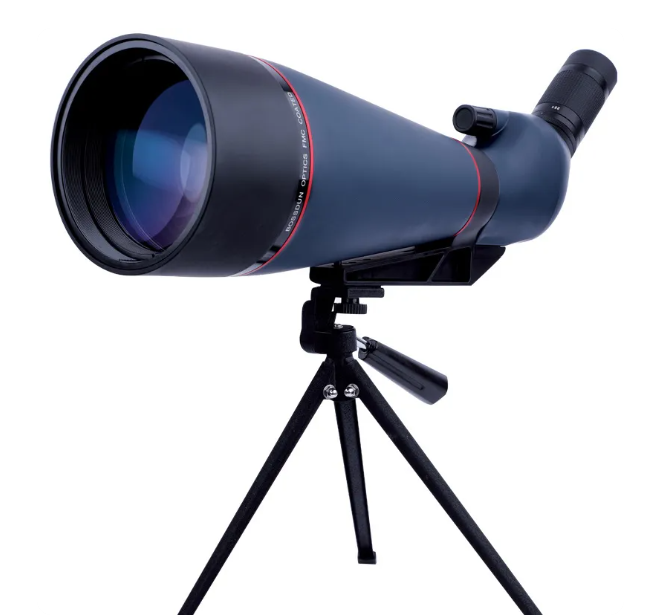
Spotting scopes are very important tools. They work well for many different outdoor activities. These activities include birdwatching, hunting, target shooting, and nature observation. They give higher magnification than binoculars. This makes them perfect for clear long-distance viewing.
However, not all spotting scopes are the same. The main technologies help their performance. These include lens coatings, optical design, stabilization, and waterproofing. They play a big part in the total quality and how people use them.
In this article, we will explain the main technologies behind spotting scopes. We will focus on how lens coatings, optical design, and stabilization systems make performance better. This will help you understand how to check spotting scopes from a tech view. It ensures you make a smart choice. This is whether you are a technical buyer, an OEM procurement manager, or an enthusiast looking for the top performance.
Lens coatings are one of the smartest features in these tools. They control light and cut down problems that hurt the view. This section looks at why they matter and what kinds work best.
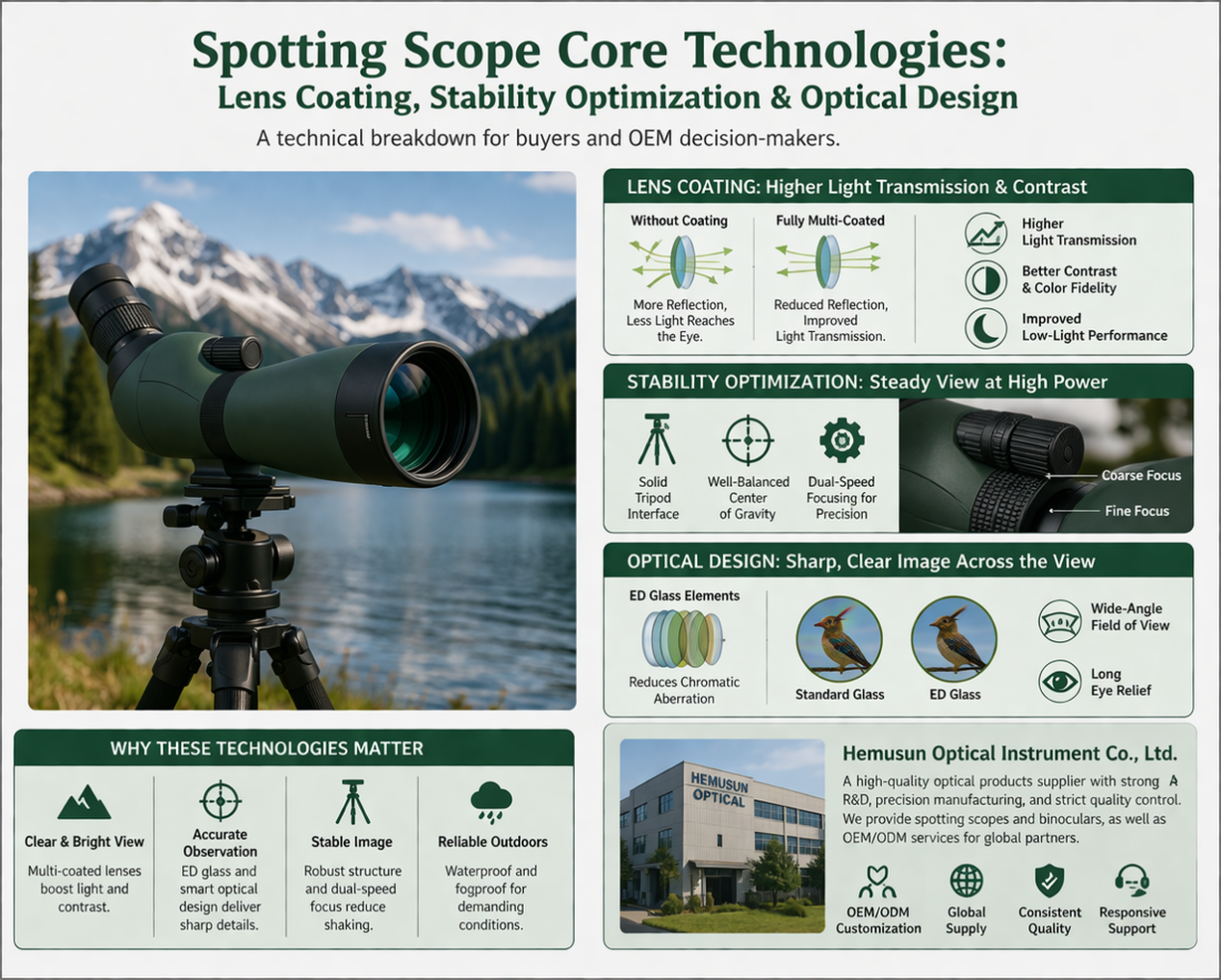
One main thing decides how good a spotting scope works. It is its optical coatings. These coatings go on the lenses. They manage how much light goes through. They also cut down reflections. Reflections can make image quality worse.
They have a very important job. They improve light transmission. This is very needed for low-light performance. It also helps contrast in your images.
Without coatings, a big part of light gets lost. It happens because of reflection off the glass surfaces. This leads to a darker image. It also causes less clear difference.
Good coatings are like fully multi-coated (FMC) or broadband coatings. They make sure as much light as possible goes through. They give clearness. They also help cut down chromatic aberration. Chromatic aberration is color fringing. It can happen when light bends through the lenses.
There are some kinds of coatings. Spotting scopes can have them.
These coatings do more than make the optical performance of the spotting scope better. They also cut down glare. They improve color fidelity. This helps the whole viewing experience feel more real and sharp.
A steady view is just as important as clear optics. Without good stability, even small shakes can ruin the image at long distances. This section explains how stabilization works and why it helps so much.
Stability is another very important thing. It decides how well the spotting scope works. This is especially true at high magnifications. Even a small vibration can make the image fuzzy. It makes it hard to focus on things far away.
Stabilization means the system that cuts down these vibrations. It makes the image stay steady and sharp.
A usual way to stabilize a spotting scope is by putting it on a tripod. But just tripod compatibility is not enough. It does not guarantee stability.
A spotting scope needs to be made to give a strong and shake-resistant base. Important things include a solid mounting system. It also has a low center of gravity. And it uses tough construction materials. These can soak up and soften vibrations.
One useful feature in good spotting scopes is dual-speed focusing. This system lets users focus fast with the coarse adjustment. Then they fine-tune the focus with the micro-adjustment knob.
This makes sure of very good accuracy. It is very needed when looking at small details far away.
Dual-speed focusing also cuts down image shakiness. This shakiness comes from sudden focusing changes. It lets users make smaller and more steady adjustments. So the image stays still and clear. This happens even during high-magnification use.
The lenses inside a spotting scope do more than just magnify. Their special design and materials make the picture sharp and wide. Let us see how these parts improve your view in real outdoor situations.
Extra-low dispersion (ED) glass is a very important part. It is in today’s top spotting scopes. ED glass cuts chromatic aberration. This happens when different colors of light bend at different ways.
This glass makes sure light wavelengths meet at the same focal point. It gives sharper and brighter images.
ED glass is very useful at high magnifications. It keeps clearness across the whole field of view. It cuts color fringing. It makes the total image quality better.
The field of view (FOV) is another key thing to think about. You consider it when picking a spotting scope. A bigger FOV lets you see a larger area. It makes it easier to follow moving subjects. These subjects include birds or wildlife.
Spotting scopes with a wide-angle design give a more real and fun viewing experience. This is especially true in busy outdoor environments.
Even though a wide FOV is good, you must balance it. You balance it with the need for clearness from edge to edge. Good optical designs keep sharpness from the center to the edges of the view. This makes sure there is no big distortion.
Outdoor use means dealing with rain, snow, or sudden temperature changes. That is why strong protection features are a must for any good spotting scope. Here we look at how these features keep the tool working well.
Spotting scopes get used in many different weather conditions. These go from humid forests to snowy mountains. To make sure they work well in these places, the scopes need to be waterproof and fogproof.
These features stop moisture from getting into the lenses. They prevent fogging on the internal surfaces. So you get a clear view no matter the outside conditions.
Waterproofing usually uses sealed O-rings and nitrogen purging. They stop water and dust from entering the optical housing. Fogproofing keeps a stable internal pressure. It avoids condensation. This happens when the scope goes from a cold to a warm environment.
Durability is another key thing. You look at it when checking spotting scopes. A strongly made scope can handle tough environments. It does not hurt its performance.
The construction materials should be tough enough. They handle rough handling, impacts, and extreme weather conditions. This ensures long-term reliability and durability.
Hemusun Optical Instrument Co., Ltd. is a leading supplier. They provide high-quality optical products. These include spotting scopes, binoculars, and telescopes. They focus on precision engineering and advanced optical design.
Hemusun makes sure all of its products reach the highest standards. These standards are for performance and durability. Their spotting scopes give clear and sharp images. They also offer stable viewing experiences.
This makes them perfect for outdoor enthusiasts and professionals alike.
Hemusun’s dedication to innovation and quality makes them a trusted partner. They work for OEM and ODM projects. Whether you look for a customized solution or a mass production option, Hemusun can meet your specific needs.
Spotting scopes are very important tools. They help with long-distance observation. Understanding the technologies behind their performance is key. It helps you pick the right one.
Key factors like optical coatings, stabilization systems, ED glass, and waterproofing are very important. They ensure high-quality imaging and durability. By thinking about these things, you can make a smart decision. You do this when selecting a spotting scope for your specific needs.
Many people have questions when they shop for spotting scopes. The answers below cover the most common points and can help you decide.
Lens coatings are very important. They cut down reflections. They improve light transmission. They also make the clarity and brightness of the image better. Good coatings ensure better contrast. They give good color fidelity. They improve overall optical performance. This is especially true in low-light conditions.
Stabilization helps cut down vibrations. These vibrations can make the image fuzzy. It happens at high magnifications. It makes sure the image stays steady and clear. This improves the overall viewing experience.
ED glass is a type of optical glass. It cuts chromatic aberration. This gives sharper and brighter images. It is very useful in high-magnification scopes. There, keeping image clarity is very important.
Yes, waterproof and fogproof features are very needed. They ensure reliable performance in many weather conditions. These features stop moisture from entering the scope. They keep images clear even in humid or rainy environments.
When picking a spotting scope, think about some factors. These include optical coatings, ED glass, magnification, field of view, and stabilization. Also, make sure the scope is durable. It should be waterproof and fogproof. This is for use in all weather conditions.