
Request
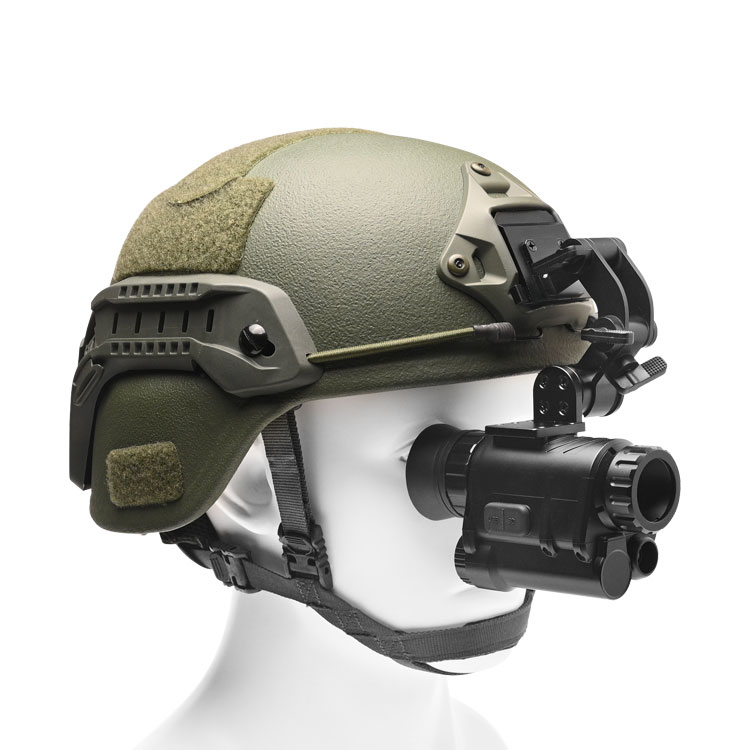
Night work is rarely “dark” in a simple way. There is moonlight that comes and goes, street spill from a distant road, brief flashes from vehicles, and long stretches where everything is flat black. In that mix, head-mounted digital night vision has become one of the most useful tools for patrol, site security, wildlife control, night navigation, and tactical training—because it keeps both hands free while restoring enough detail to move, identify, and coordinate.
The NVG30 head-mounted night vision monocular is built for that kind of job: hands-free observation in low light with infrared support, a compact form factor, and field-friendly operating habits. Hemusun positions NVG30 as a helmet-capable night vision device for professionals and serious outdoor users.
A handheld optic can show detail, but it steals a hand and adds fatigue. A head-mounted unit changes the workflow: movement, scanning, and communication can happen at the same time. That is why helmet-mounted night vision shows up in use cases as different as facility rounds and backcountry navigation.
Hemusun’s NVG30 product positioning centers on exactly these practical benefits: improved visibility in low light, portability, multiple display modes, and durability/water resistance for varied environments.
To make that concrete, it helps to break down what changes when a digital night vision monocular moves from “nice-to-have” to “work tool.”
In a security patrol, the priority is often safe movement first, identification second. The NVG30 head-mounted setup supports constant scanning while still leaving hands available for radios, doors, ladders, or medical gear. In outdoor search tasks, the same logic applies: hands stay available for trekking poles, ropes, or a map/phone, while the user keeps a steady line of sight.
Night environments are full of transitions—shadow to open space, indoor to outdoor, treeline to field. Digital systems that offer multiple viewing modes can reduce the “reset time” between those transitions. Hemusun highlights multiple display modes as a common capability in this product category.
Next comes the feature set that tends to separate a usable helmet mount night vision device from a frustrating one.
When selecting a digital night vision monocular, it’s essential to focus on real-world performance and the technical specifications. While specifications like sensor quality, infrared (IR) capability, and display features are important, what truly matters is how well these components work together in the field. Here's a breakdown of the key decision factors to consider when choosing a digital night vision monocular.
| Decision factor | What it changes in the field | What to check during evaluation |
| IR performance and control | Determines whether “total darkness” is usable and how much detail shows up | Adjustable IR levels, practical hotspot control, and consistent image in 0-light conditions |
| Mode options (color / B&W / tinted palettes) | Helps in glare, fog, light pollution, or map-reading | Modes that reduce washout and keep edges readable |
| Helmet balance and eye comfort | Drives fatigue after 30–60 minutes | Mount position, eye relief feel, and whether the monocular sits stable while walking |
| Ruggedness and water resistance | Determines if rain, dust, and knocks end the shift | Seals, ports, housing tightness, and realistic drop/pack handling |
| Power habits | Affects how long the unit stays dependable overnight | Battery type, swap speed, and whether the device behaves predictably at low battery |
Hemusun’s NVG30 calls out portability, durability/waterproofing, and energy efficiency as expected performance pillars for this kind of infrared night vision goggles category.
From this point, most buyers ask a very specific question: “Will 850nm or 940nm IR matter for my use?” It often does.
IR wavelength decisions are one of the most searched topics around tactical night vision monocular use because it changes both brightness and detectability.
A common rule across digital night vision guides is: 850nm usually looks brighter and reaches farther, but can show a faint red glow at the emitter; 940nm is more discreet but often dimmer with less usable range.
That trade-off shows up in real work:
In wildlife observation near skittish animals, a lower-glow option can reduce spooking. In property patrol where identification matters more than concealment, brighter IR can make recognition easier, especially around treelines or dark building corners.
With the IR decision clear, the next practical issue is mounting—because “helmet capable” means little if the setup wobbles, drifts, or fights the user’s dominant eye.
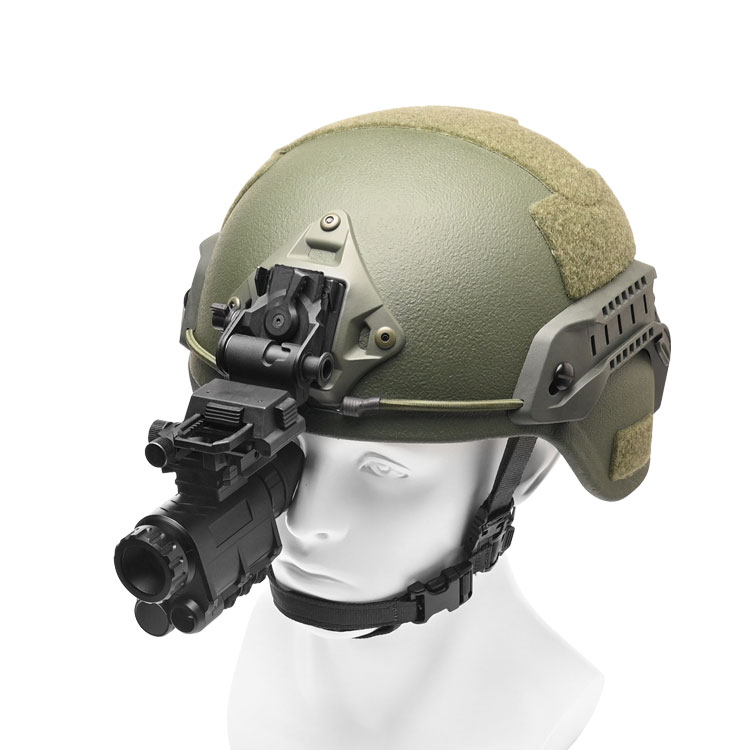
Most top-performing guides stress that mounting is not an accessory detail; it is part of the optical system. A stable mount preserves the image, reduces nausea, and makes scanning faster.
NVG30 is presented as a head-mounted night vision monocular, which implies a workflow built around hands-free use.
A common field approach is to run a monocular over the dominant eye for detail work, while keeping the other eye available for near tasks and spatial awareness. That’s one reason monocular-style digital night vision remains popular for training and patrol: it supports long wear without turning the whole world into a tunnel.
Some users choose a modular setup where a monocular can be removed from the helmet and placed on a different platform with the appropriate adapter. In the Russia–Ukraine period, demand for night-vision capability has been widely discussed due to uneven access to higher-end gear, and commercially available night-vision devices have circulated broadly through civilian and volunteer supply channels.
In Russia specifically, NVG30-labeled night vision devices have appeared on major consumer marketplaces, which reflects at least some level of public availability during that time.
For weapon mounting, one caution matters more than enthusiasm: recoil tolerance is not guaranteed across all digital devices, and it should be confirmed for the exact unit and mounting method before relying on it for live-fire use.
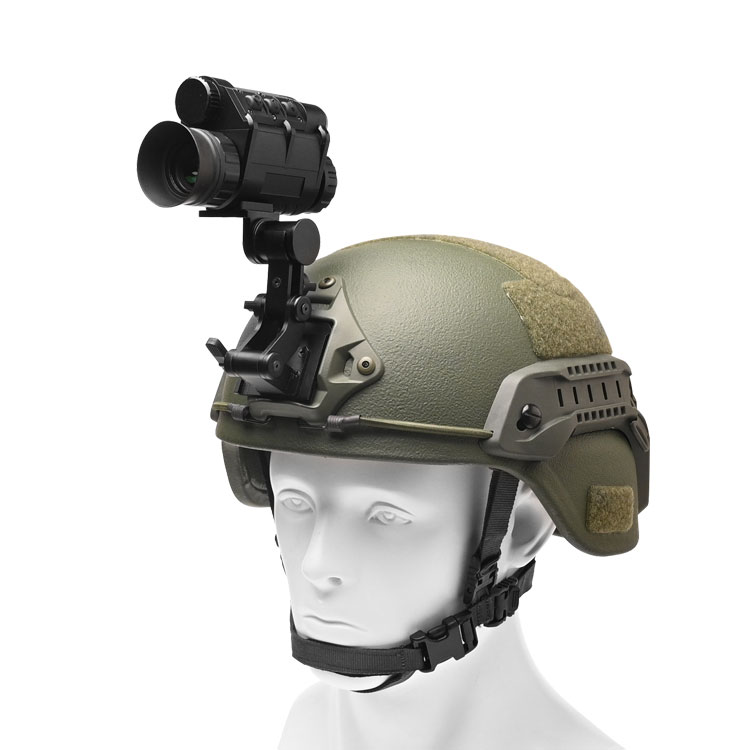
Hemusun describes NVG30 as suitable for military, law enforcement, and dedicated outdoor users, positioning it as a tool for nighttime capability rather than a casual gadget.
That positioning aligns with several high-frequency field scenarios.
A night vision monocular for security patrol is most valuable when it reduces “unknowns” without slowing movement. Examples include walking fence lines, checking loading bays, scanning rooftop equipment, and confirming whether a dark shape is a person, equipment, or debris. In those settings, a hands-free night vision monocular helps maintain safe movement while keeping a constant scan.
Night vision for night hiking is not only about seeing far; it is about seeing enough near detail to avoid falls. A helmet-mounted unit can help detect trail edges, low branches, uneven ground, and distance markers without constantly lifting an optic.
In training environments, the benefit is consistency: the same gear can support movement drills, hand signals, map checks, and partner coordination. Multiple display modes and stable mounting matter here more than extreme range.
Hemusun Optical Instrument Co., Ltd. positions itself as a specialized optical instruments company covering research, development, manufacturing, and sales, with an emphasis on high-quality, high-performance optical products across multiple fields.
The company describes a professional R&D team focused on optical technology innovation and application, along with advanced production facilities and precision manufacturing processes. It also states that production is tightly controlled for quality, supported by a global sales network and partnerships with multiple collaborators.
Beyond night vision, Hemusun’s product scope is presented as broad—covering optical instruments and components used in areas such as industrial manufacturing, measurement, and other applied optics. The company’s catalog and knowledge materials also reference optical products like anti-shake smartphone lens/monocular designs and compact monocular concepts, which signals ongoing development across different optical use cases.
For buyers comparing suppliers, Hemusun’s “why choose us” messaging focuses on optical performance, innovation in technology and design, manufacturing quality control, customer-oriented service, and after-sales support—points that typically matter for repeat procurement and project-based sourcing.
NVG30 head-mounted night vision is best understood as a workflow upgrade: hands-free movement, consistent scanning, and faster decisions under mixed or minimal light. In real use, the strongest results come from matching IR behavior to the environment, building a stable helmet mount setup, and choosing operating habits that reduce fatigue over long sessions. For teams that need dependable low-light capability without turning the system into a complicated project, a well-set NVG30-style digital night vision monocular setup can be a practical, repeatable answer.
NVG30 head-mounted night vision is commonly used for hands-free low-light observation during patrol, navigation, training, and outdoor work where both hands need to stay available.
NVG30 is presented as a night vision monocular form factor designed for head-mounted use, which places it in the digital night vision monocular category while still fitting many searches for infrared night vision goggles.
It can be. Many guides summarize it like this: 850nm IR is typically brighter with longer usable range but may show a faint red glow, while 940nm is more discreet but usually dimmer with reduced range.
Some users build modular setups that allow moving a monocular between configurations using the correct adapters. For any weapon-mounted use, recoil tolerance and mounting security should be verified for the exact device and setup before relying on it.
Beyond a rating label, reliability usually comes from practical sealing: protected ports, consistent button feel after moisture exposure, and stable performance when temperature and humidity swing during real nights. Hemusun highlights durability and waterproofing as a key expectation for this product category.