
In real deployments, thermal and low-light fusion imaging is less about having “more cameras” and more about making faster, cleaner decisions when the scene is confusing, the lighting is uneven, and the operator on shift is juggling too many alerts. If you buy the wrong setup, you get the familiar pattern: the thermal channel sees something but can’t explain it, the low-light channel shows a grainy scene that’s hard to interpret, and the team wastes minutes flipping views while an incident keeps moving. If you buy the right setup, you get a tight alarm verification workflow that moves from detection to confirmation to evidence without drama.
This article is written for B2B buyers—security integrators, procurement teams, project managers, and OEM partners—who need a practical way to specify, deploy, and test dual sensor imaging so it holds up after the demo. It stays focused on perimeter security system design and field operations, while giving you language you can put into an RFQ for thermal imaging, acceptance testing, and day-to-day operations.
Most sites don’t struggle to “see at night.” They struggle to decide what they’re seeing fast enough to act. That sounds subtle, but it’s the difference between a system that looks impressive in a sales clip and one that reduces operator fatigue during a long shift.
Consider a distribution yard with a perimeter fence, loading docks, and intermittent lighting from poles and building wash lights. At 2:30 a.m., the yard is mostly dark, but every time a truck swings wide, headlights splash across the scene and create hard shadows. A standard visible channel might show detail when the truck is present, then fall apart as it leaves. A low-light channel may keep the scene “readable,” but it can still struggle with glare and contrast swings. A thermal channel may detect a person walking along the fence line with confidence, yet the operator still needs context—are they carrying a tool, are they in a uniform, are they approaching a gate or simply passing behind vegetation?
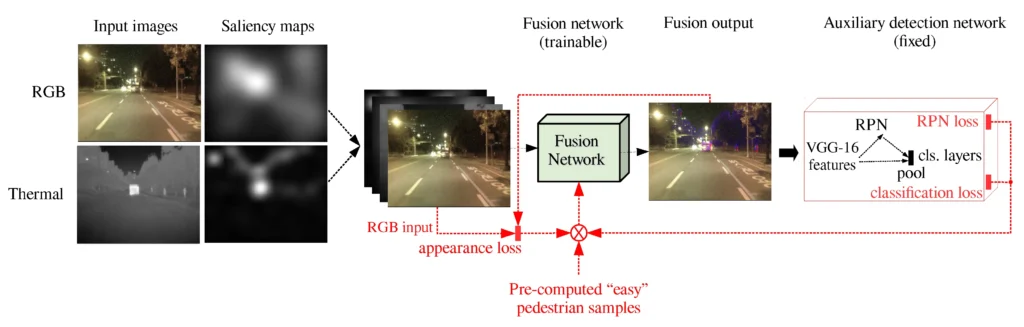
Fusion, in this context, is not a buzzword. It is a design choice that ties detection and verification together so the system produces an answer, not just an image.
Many projects use two channels without calling it fusion at all. The question is how those channels behave as a system.
The most common approach is straightforward: thermal imaging handles early detection and tracking, while low-light imaging handles verification and documentation. You are not forcing one sensor to do everything. You are assigning jobs based on what each technology does best in the real world, especially when lighting is inconsistent.
This approach can be highly effective if the operator can move between channels quickly and if the cameras are positioned so the target stays in view during the handoff. When those conditions are not met, “two channels” becomes “two separate problems.”
In many environments, operators lose time not because the system missed the target, but because the scene is hard to parse. A thermal overlay, sometimes described as thermal target highlighting, can help the operator immediately locate what triggered the alarm inside a visually busy scene. The practical value is speed. A few seconds saved per event becomes meaningful when there are dozens of alerts per night and the team is trying to keep response decisions consistent.
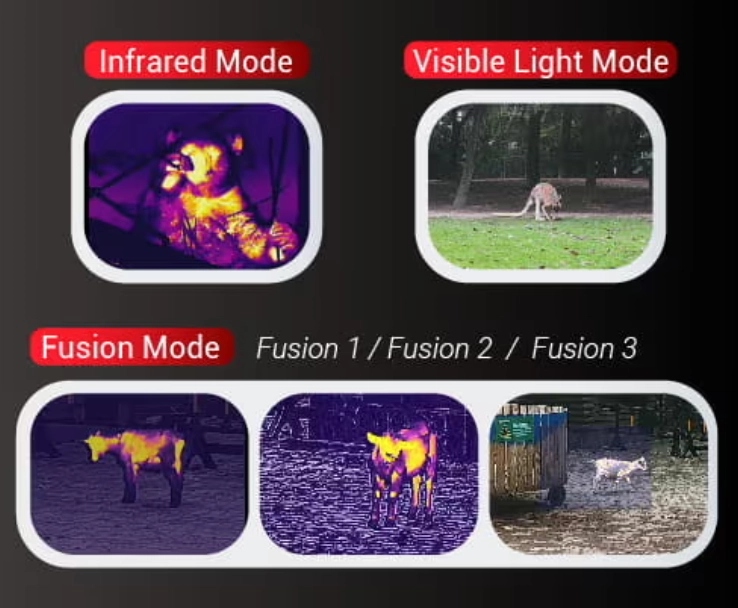
True dual sensor imaging—two sensors aligned to the same view—can simplify operations because the operator isn’t hunting across different perspectives. The tradeoff is that alignment and calibration matter more, and mechanical realities show up fast: mounting rigidity, vibration, and small changes in angle become workflow problems.
If you’re buying for a project, ask how the system behaves after a season of weather, maintenance cycles, and small bumps. If you’re buying for an OEM product line, consider whether alignment is something your customers will tolerate managing in the field.
Fusion only pays off when it reduces time-to-decision and reduces nuisance events. That requires a defined workflow, not just hardware.
Thermal is often best used as the first-line detection layer because it is not dependent on visible lighting. In perimeter security, that means fewer missed detections in dark zones and fewer “nothing there” moments when the visible channel is dealing with shadow transitions. Thermal can also maintain tracking when a target moves through uneven illumination, which is exactly where many false alarm patterns begin.
Once thermal flags a target, low-light imaging does the human job: confirming what the target is doing. This is where many security teams win back time. An operator can distinguish a person walking a dog outside the fence from someone testing a weak point, or confirm whether a subject is carrying equipment. Low-light also tends to produce scenes that are easier to explain to non-technical stakeholders, which matters when incidents become reports.
A good alarm verification workflow ends with footage that is usable. Not just technically recorded—usable. That means the scene is understandable, the event timeline is clear, and the target behavior can be described without relying on “trust me” explanations.
For many buyers, this is the point where fusion stops being a technology discussion and becomes a business discussion. Evidence-grade documentation reduces internal disputes, speeds up claims, and improves post-incident reviews.
This section is intentionally practical. It is also where most RFQs are too vague.
If the thermal channel is wide and the low-light channel is narrow, the operator may see the target in thermal but fail to locate it quickly in low-light. The reverse can also happen. Field of view matching does not mean both channels must be identical, but the handoff should feel natural. At the distance where thermal detection matters, the low-light channel should cover enough area to confirm without searching.
In perimeter security system design, that single factor—how quickly a person can be found in the verification channel—often determines whether your system actually reduces false alarms.
One reason buyers get disappointed is that they expect one channel to deliver both long-range detection and close-range identification. In practice, thermal does early warning well, while low-light is often where identification and context live. Your RFQ should reflect that by describing detection distance requirements separately from verification and identification needs.
If an operator has to open a new view, scroll to a different camera group, and guess which direction the target moved, fusion becomes friction. A well-designed system makes the next view obvious. In many deployments, the right handoff design lowers response time more than any individual specification change.
If you want quotes that match reality, write your RFQ as a story about what the system must do.
Start with a scenario: time window, lighting conditions, and typical background motion. Specify the action the operator must take: dispatch, escalation, or documentation. Then define success in operational terms: how fast confirmation should happen, what counts as a nuisance event, and what level of detail is required for reporting.
When you include acceptance testing in the RFQ, you avoid arguments at the end of the project. Describe how you will test alarm verification workflow, including how many runs, what routes a subject walks, and how you will record time-to-confirmation. You do not need to drown the vendor in jargon. You do need to remove ambiguity.
If you are sourcing components or complete devices for a broader product line, it also helps to add OEM requirements early. That can include branding, configuration, and interface expectations when applicable. For reference on product categories and availability, you can point stakeholders to Hemusun’s full product lineup so engineering and procurement are working from the same baseline. For projects that require tailored configurations, customisable device options for OEM and project sourcing can be a practical starting point when you’re discussing integration details and deliverables.
Fusion is easiest to justify when you tie it to operational cost.
In industrial perimeter security, the cost is often labor. A high false alarm rate forces more patrols, more radio calls, and more “check it anyway” behavior. Thermal-triggered alerts combined with low-light verification can reduce that workload because fewer alerts require human eyes for long periods. The time savings is not theoretical; it shows up in shift performance and consistency.
In field operations and night patrol, the cost is delay and uncertainty. Teams working at night often need fast triage: locate, confirm, move. Thermal helps locate. Low-light helps confirm. A coherent workflow prevents the common failure where teams spend precious minutes debating what a vague image means.
In asset-adjacent wildlife monitoring—solar farms, remote pipelines, outdoor storage—thermal detection is useful because animals and people stand out quickly. Low-light can help differentiate behavior when the next decision matters, especially when you need a record that non-specialists can interpret during a review.
A fusion-first approach typically means you are sourcing more than a single product. You are building a system that combines detection reliability with scene understanding and documentation. Hemusun Optical Instrument Co., Ltd. supports this kind of sourcing conversation by offering a broad range of outdoor optronics categories—covering observation optics and night-use devices—while also supporting projects that need customisable builds for specific deployment requirements.
For teams building a standardized offering across multiple sites, the ability to source consistently matters as much as the performance of any single unit. For OEM buyers, the conversation often shifts to configuration control, branding deliverables, and practical integration constraints. Those topics fit naturally within a fusion procurement plan, where devices are expected to work together as part of a defined workflow rather than as isolated products.
If you want the company background in one place, Hemusun Optical Instrument Co., Ltd. company profile provides the high-level overview that many procurement packages require before moving to technical alignment.
Thermal and low-light fusion imaging works when you treat it as a workflow: thermal for fast detection and steady tracking, low-light for intent verification and usable documentation, and a handoff design that keeps operators from hunting for the next view. When buyers skip that workflow thinking and only compare hardware specs, they end up with a system that looks good in a demo but feels slow and uncertain during real alarms.
Write your RFQ in operational language, plan field of view matching as a design choice, and build acceptance testing around time-to-confirmation rather than generic “image quality.” That approach makes quotes more comparable, deployments more predictable, and post-install complaints far less common.
Thermal and low-light fusion imaging combines thermal detection with low-light verification so operators can confirm alarms faster. Thermal is often used to spot and track targets reliably at night, while low-light footage provides scene context that supports decision-making and reporting.
Thermal overlay can help reduce operator time spent on alerts by making targets easier to locate within a busy scene. It usually does not eliminate nuisance triggers by itself, but it can speed up alarm verification workflow and reduce operator fatigue when events are frequent.
Start by defining the distance where thermal detection must work, then design the low-light channel so it covers enough of that same area to confirm quickly. Field of view matching is less about identical angles and more about minimizing “search time” during handoff in real operations.
A strong RFQ for thermal imaging and low-light verification describes scenarios: time of day, lighting conditions, target distance, and the operator action required. It should also include acceptance testing language that measures time-to-confirmation and describes how nuisance events will be evaluated.
Acceptance testing should simulate real conditions, including typical background motion and lighting changes, and record how quickly an operator can move from thermal detection to low-light confirmation. The goal is not a perfect-looking image, but a repeatable process that supports correct dispatch decisions.